


Can a Snake Bite Through Rubber Boots?
Oct 29, 2026
View: 9
Leave a message
Rubber boots are widely used for hunting, farming, gardening, fishing, and other outdoor activities. They keep feet dry and protect against mud, moisture, and rough ground. However, people working in areas where venomous snakes live need to consider another question: will ordinary rubber boots provide enough protection against a snakebite?
The answer depends on the boot's material, construction, coverage, and intended purpose. Standard rubber boots are designed primarily for waterproofing, not snakebite prevention. Leather boots also provide a physical barrier, but ordinary leather footwear should not automatically be considered snake-proof.
For outdoor users, understanding these differences helps with footwear selection. For distributors and brands, it also provides a practical basis for evaluating product specifications and protective claims. As a rubber footwear manufacturer, Patcus focuses on matching footwear construction and product features to different working and outdoor applications.
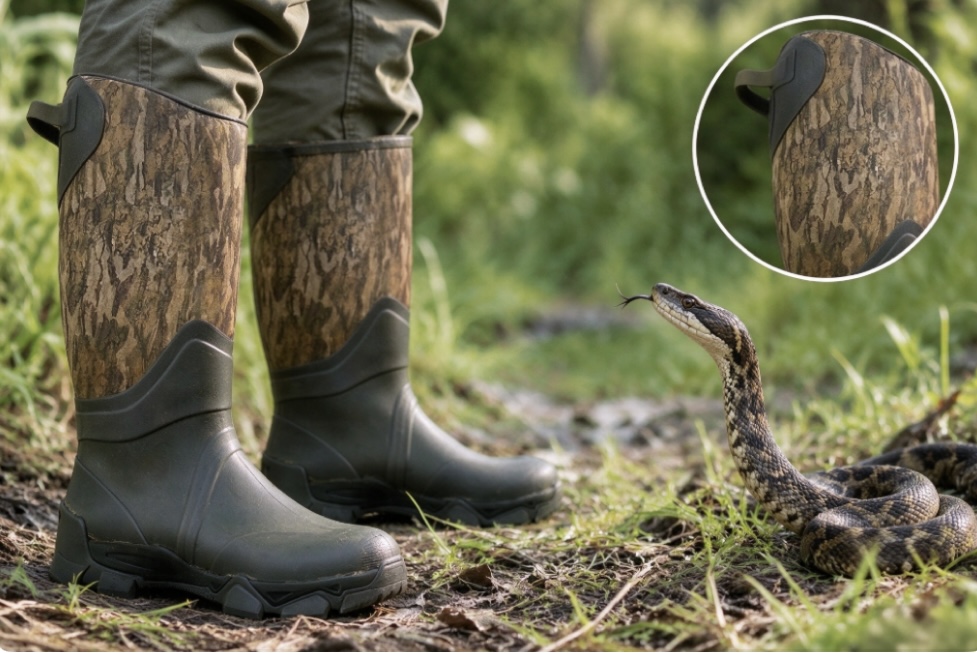
Will a Snake Bite Through Different Types of Rubber Boots?
Not all rubber boots provide the same level of protection. A boot designed for rainy weather may have a different construction from footwear intended for demanding outdoor environments.
| Boot Type | Primary Purpose | Snakebite Protection |
|---|---|---|
| Standard rubber rain boots | Waterproofing and everyday outdoor use | Not guaranteed |
| Rubber hunting boots | Hunting and outdoor activities | Depends on construction and testing |
| Heavy-duty rubber boots | Demanding work environments | Thickness alone does not guarantee protection |
| Snake-protection boots | Reducing snakebite risk | Depends on verified testing and coverage |
| Snake gaiters | Additional lower-leg protection | Depends on design and tested performance |
Ordinary rain boots should not be treated as snake-proof. Even a tall boot with thick rubber may have vulnerable areas around seams, joints, or thinner sections.
The CDC guidance for outdoor workers exposed to venomous snakes recommends wearing boots and long pants. It also identifies specialized equipment, such as snake-proof boots and puncture-resistant gaiters, as protective options for certain work environments. This distinction matters: general outdoor footwear and specialized protective footwear are not interchangeable.
What Determines Whether a Snake Can Penetrate Rubber Boots?
Several factors influence the protection a rubber boot will provide. Material thickness matters, but it is only one part of the overall construction.
1. Material Composition and Construction
Rubber boots vary in compound formulation, wall thickness, flexibility, and manufacturing structure. These characteristics affect durability, fit, and resistance to physical damage.
However, thicker rubber does not automatically mean better snakebite protection. A boot should be evaluated according to its intended use and the hazards it is designed to address.
The ASTM F2878 test method evaluates protective clothing materials against penetration by specified hypodermic needles. It provides an example of how material resistance can be assessed under controlled conditions. However, a needle-puncture result does not directly prove that a boot will prevent a snake's fangs from penetrating it. Buyers should request test evidence relevant to the specific protective claim.
2. Boot Height and Coverage
Boot height determines how much of the lower leg is covered. Tall rubber boots provide more coverage than ankle-height footwear and are useful in wet grass, muddy fields, and areas with dense vegetation.
Nevertheless, shaft height alone does not establish snakebite resistance. The material, construction, and protection around vulnerable areas must also be considered.
3. Fit and Structural Condition
A secure fit supports stable movement during outdoor work. Boots should not restrict circulation or make walking difficult.
Their physical condition is equally important. Cuts, cracks, damaged seams, and worn material may affect the boot's integrity. Regular inspection is particularly important after walking through rough vegetation, rocks, or uneven ground.
Will Snakes Bite Through Leather Boots?
Leather boots provide a physical barrier between the foot and the surrounding environment, but their protective performance depends on the leather type, thickness, construction, and coverage.
A thick leather work boot has a different structure from a lightweight fashion boot. Stitching, flexible panels, openings, and thinner sections may also affect the overall barrier.
The U.S. National Park Service's outdoor safety guidance identifies sturdy footwear as an important precaution in outdoor environments. However, this does not mean that every leather boot will stop snake fangs.
Buyers should distinguish between general protective footwear and products specifically designed and tested for snakebite protection. A leather boot's appearance or thickness alone will not establish its protective performance.
Are Cowboy Boots Enough to Protect Against Snake Bites?
Traditional cowboy boots provide coverage above the ankle and are used in ranching and outdoor activities. However, their protective performance varies with the leather, shaft construction, stitching, and overall design.
A standard cowboy boot should not be treated as a substitute for specialized snake-protection footwear when the risk is high. Buyers working in snake-prone environments should check whether the product has relevant test documentation rather than relying on its style or material description.
Rubber Boots vs. Leather Boots: Which Offers Better Snakebite Protection?
Rubber and leather have different material properties, but neither material guarantees protection against snakebites.
Rubber boots are particularly useful in wet environments because their construction supports waterproofing and cleaning. They are suitable for muddy fields, marshes, wet grass, and many agricultural applications.
Leather boots are commonly selected for their structured construction and suitability for certain outdoor and work environments. Their performance depends on leather thickness, reinforcement, and design.
The peer-reviewed research on venomous snakebite prevention in mountainous terrain discusses protective clothing such as long boots and gaiters as part of a broader prevention approach. It also emphasizes awareness of the environment and avoiding direct contact with snakes.
For buyers, the practical choice should be based on the working environment, waterproofing requirements, comfort, coverage, and verified protective performance—not simply whether the upper is made from rubber or leather.
Rubber Boots vs. Snake Gaiters: Which Is Better?
Rubber boots and snake gaiters serve different purposes.
Rubber boots are suitable for wet grass, muddy fields, marshes, and other damp environments. Their waterproof construction helps keep feet dry during outdoor activities.
Snake gaiters provide an additional protective barrier around parts of the lower leg and are designed to be worn with suitable footwear. They may be appropriate for work or outdoor activities where snake encounters are a recognized hazard.
The CDC/NIOSH bulletin on venomous snakes as an occupational hazard advises employers to consider appropriate personal protective equipment, including snake-proof boots or puncture-resistant gaiters, according to workplace risks.
Neither boots nor gaiters should be assumed to provide complete protection under every condition. Product claims, coverage, and test evidence all need to be reviewed.
How to Choose Rubber Boots for Snake-Prone Areas
When selecting footwear for farmland, wooded areas, tall grass, or other snake-prone environments, buyers should consider several factors.
Check the Intended Protection Level
Determine whether the requirement is waterproof outdoor footwear or footwear specifically designed to reduce snakebite risk. These are different product requirements.
If snakebite protection is essential, request documentation supporting the product's protective claims. Terms such as "heavy-duty," "thick rubber," and "outdoor protection" do not, by themselves, demonstrate resistance to snake fangs.
Consider the Terrain
Muddy fields, wet grass, and uneven woodland trails require suitable tread patterns, stable footing, and appropriate shaft height. Waterproofing and traction are useful features, but they do not prove snakebite resistance.
For outdoor applications, buyers can explore Patcus rubber hunting boots and compare product specifications with their intended requirements.
Review Material and Construction
Check the rubber compound, boot structure, shaft height, sole design, and condition of seams and joints. Product specifications should match the intended application.
Request Relevant Test Documentation
If a product is marketed for snakebite protection, buyers should confirm which test method was used, what components were evaluated, and what the results actually demonstrate.
How to Reduce Snakebite Risk When Wearing Rubber Boots
Footwear is only one part of snakebite prevention. Outdoor users should also follow basic safety practices:
- Watch where you step, especially in tall grass, leaves, and areas with limited visibility.
- Keep a safe distance from snakes and never attempt to catch, handle, or kill them.
- Use a flashlight when walking outdoors in low-light conditions.
- Check boots and other equipment before use, especially after outdoor storage.
- Avoid reaching blindly into brush, holes, rock crevices, or piles of debris.
- Follow workplace safety procedures and use additional protective equipment when the risk assessment requires it.
The World Health Organization's guidance on snakebite prevention emphasizes suitable footwear and awareness of local snake hazards. These precautions help reduce exposure, but no footwear choice will eliminate every risk.
If a snakebite occurs, seek emergency medical attention immediately. Do not attempt to cut the wound, suck out venom, or apply a tourniquet.
What Should Buyers Check When Sourcing Rubber Boots?
For distributors, retailers, and private-label brands, choosing the right rubber boots begins with a clear understanding of the target market.
- Define the application: Identify whether customers need rain boots, hunting boots, agricultural footwear, or specialized protective footwear.
- Confirm product specifications: Review materials, shaft height, outsole construction, available sizes, and other relevant features.
- Verify protective claims: Request test reports when snakebite protection is part of the product's selling proposition. General puncture-resistance results should not be presented as proof of snakebite protection without supporting evidence.
- Discuss OEM requirements: Confirm available models, branding options, packaging, size assortments, minimum order quantities, and production lead times with the manufacturer.
Patcus provides rubber footwear manufacturing and OEM services for business customers. Distributors and brands can visit the Patcus official website to learn more about its product range and discuss footwear requirements. Any specialized snakebite-protection claim should be verified against the specific product and its supporting test documentation.
Frequently Asked Questions
Will a snake bite through thick rubber boots?
Yes, penetration may still be possible. Rubber thickness alone does not establish resistance to snake fangs. Material composition, construction, coverage, and relevant test evidence all matter.
Will snakes bite through leather boots?
A snake may penetrate some leather footwear. The result depends on leather thickness, boot construction, and the location of contact. Ordinary leather boots should not be considered snake-proof.
Are rubber boots safer than leather boots?
Neither material is automatically safer. Rubber boots are useful in wet environments, while leather boots provide a different type of footwear construction. Specific protective performance must be supported by relevant testing.
Are ordinary rain boots suitable for snake-prone areas?
They provide waterproofing and general outdoor coverage, but they are not necessarily designed for snakebite protection. Where the risk is significant, buyers should consider footwear specifically developed and tested for that purpose.
What should I look for in snake-protection boots?
Check the product's intended protective function, material construction, coverage, and relevant test documentation. Confirm exactly what the testing demonstrates before relying on a snakebite-protection claim.
Conclusion
Ordinary rubber boots and leather boots both provide useful coverage for outdoor activities, but neither should automatically be considered snake-proof. Their protective performance depends on material properties, construction, coverage, and evidence from relevant testing.
For outdoor users, choosing footwear according to the working environment and following established snakebite-prevention practices will help reduce risk. For distributors and brands, working with an experienced footwear manufacturer and verifying product claims will support more accurate product selection and marketing.
References
- Centers for Disease Control and Prevention (CDC/NIOSH). Venomous Snakes at Work: Outdoor Workers.
- U.S. National Park Service. Tailgate Safety Series: Insects, Snakes, and Animals.
- ASTM International. ASTM F2878: Standard Test Method for Protective Clothing Material Resistance to Hypodermic Needle Puncture.
- Wilderness & Environmental Medicine. Venomous Snakebite in Mountainous Terrain: Prevention and Management.
- World Health Organization (WHO). Snakebite Envenoming: Prevention and Management.