


How to Evaluate a Rubber Boots Manufacturer for Bulk Orders
Oct 30, 2026
View: 4
Leave a message
How to Evaluate a Rubber Boots Manufacturer for Bulk Orders
Choosing a rubber boots manufacturer involves more than comparing unit prices. For importers, wholesalers, retailers, and private-label brands, the right manufacturing partner should provide consistent product quality, clear specifications, reliable delivery planning, and suitable OEM services.
Before placing a bulk order, buyers should evaluate the factory's production capabilities, quality control procedures, sample approval process, total purchasing costs, and communication practices. A structured assessment helps reduce avoidable sourcing risks and supports a more stable long-term partnership.
Verify the Manufacturer's Production Capability
Start by confirming whether the company manufactures rubber boots directly or sources products from other factories. A trading company may still be a suitable partner, but buyers should understand who controls production and quality.
Buyers can also review the manufacturer's rubber boots product range to understand available footwear categories and identify products that match their target markets.
Ask for details about the manufacturing process, available product categories, production scheduling, and capacity for your expected order volume. If possible, arrange a factory visit, live video inspection, or third-party audit.
Do not evaluate capacity based on factory photographs alone. Ask how the manufacturer manages peak-season demand, equipment maintenance, and unexpected production delays. A useful supplier should explain its capabilities clearly and identify any limitations before accepting an order.
Evaluate Quality Control and Product Consistency
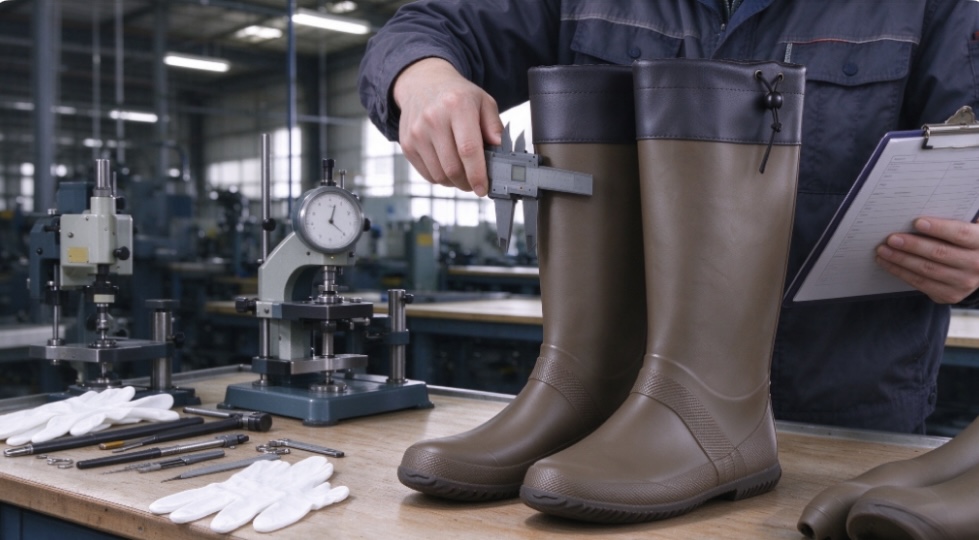
Rubber boots must meet the specifications agreed upon by the buyer and manufacturer. Depending on the intended application, important inspection points may include material appearance, boot height, outsole construction, sizing, seam integrity, and waterproof performance.
The ISO quality management principles provide a useful framework for understanding process control, customer requirements, and continual improvement. Buyers can apply these principles when reviewing a manufacturer's quality procedures, although an explanation of quality management is not proof that a particular factory holds ISO certification.
Ask the manufacturer to explain how it checks incoming materials, monitors production, inspects finished products, and handles defective items. Agree on measurable acceptance criteria before mass production rather than relying on descriptions such as "premium quality."
Where specialized protective footwear is involved, request test reports relevant to the intended protection. For example, ASTM F2412 footwear test methods cover specified protective-footwear performance tests. However, a test standard should only be used to support the properties it actually evaluates; it does not establish every possible safety claim.
Approve Samples Before Mass Production
Sample approval is an important checkpoint between discussing a product and committing to a large order.
Before approving a sample, compare it with the written product specifications. Check the overall shape, material, color, outsole design, size range, labels, and packaging requirements. For customized orders, confirm that the logo placement and artwork match the approved design.
Once the sample is accepted, keep a record of the approved version and its specifications. Use these as references when inspecting bulk production. If a material, component, or design changes later, request written confirmation and review whether a new sample is necessary.
A sample can demonstrate a proposed design, but it cannot guarantee that every unit in a production run will be identical. Buyers should still agree on inspection procedures and acceptable defect levels before production begins.
Compare Total Purchasing Costs, Not Just Unit Prices
A low unit price does not always result in the lowest overall purchasing cost. Differences in packaging, customization, minimum order quantities, shipping arrangements, and defect handling can change the final economics of an order.
Request an itemized quotation covering the product price, minimum order quantity (MOQ), sample charges, logo or packaging costs, tooling fees where applicable, payment terms, and delivery conditions.
For international orders, clarify the agreed trade term. The International Chamber of Commerce's Incoterms rules help define specific responsibilities, costs, and risks between buyers and sellers. Incoterms do not replace a complete sales contract, so payment terms, product specifications, inspection requirements, and remedies for nonconforming goods should also be documented.
Compare quotations on the same basis. A price that includes customized packaging and a different delivery arrangement cannot be compared fairly with a basic factory price without adjusting for those differences.
Check Lead Times and Delivery Reliability
For bulk orders, delivery planning can affect seasonal sales, inventory availability, and customer commitments. Ask the manufacturer to outline the main production milestones, including sample approval, material preparation, production, inspection, packing, and shipment.
Clarify whether the quoted lead time begins after deposit payment, sample approval, or another agreed milestone. Also ask how the factory communicates delays and whether changes in order quantity or specifications will affect the schedule.
A credible supplier should explain its scheduling assumptions instead of promising an unusually short lead time without reviewing the order details.
Packaging and shipment preparation also deserve attention. Confirm carton dimensions, packing quantities, shipping marks, and the availability of required export documents. These details help buyers plan warehouse receiving and freight arrangements more accurately.
Review OEM Capabilities and Order Terms
For brands and distributors, OEM services can help align products with market requirements. However, the available options should be confirmed before placing an order.
Ask which product models can be customized, what branding and packaging options are available, and whether there are minimum quantities for specific colors, sizes, or logo treatments. Confirm who approves artwork and how changes are handled after approval.
The OECD Due Diligence Guidance for Responsible Supply Chains in the Garment and Footwear Sector offers a framework for identifying and addressing risks across footwear supply chains. Buyers can use it to inform broader supplier assessments, including questions about working conditions and responsible sourcing where relevant.
Also establish clear procedures for product defects, shipment discrepancies, replacement orders, and disputes. Written agreements are more useful than relying on verbal assurances made during the quotation stage.
Rubber Boots Manufacturer Evaluation Checklist
Use the following table to compare potential manufacturers before making a bulk purchasing decision.
| Evaluation Area | What to Check | Evidence to Request |
|---|---|---|
| Production capability | Relevant manufacturing experience and order capacity | Production details, factory audit, or live inspection |
| Quality control | Inspection stages and defect management | Quality procedures and inspection records |
| Product consistency | Compliance with agreed specifications | Approved sample and written specification sheet |
| Pricing | Full cost structure and MOQ | Itemized quotation |
| Delivery | Production milestones and shipment planning | Written lead-time schedule |
| OEM services | Branding, labels, and packaging options | Customization details and approved artwork |
| Traceability | Ability to identify products or batches where applicable | Batch records and relevant shipping documents |
| Communication | Response quality and issue resolution | Written answers, responsibilities, and escalation process |
No single document proves that a supplier is suitable for every order. Evaluate the evidence together and match your checks to the product, order value, and intended market.
Questions to Ask Before Choosing a Manufacturer
Before confirming an order, ask:
- Who will manufacture the products, and where will production take place?
- What quality checks are performed before shipment?
- Can the manufacturer provide samples and written specifications?
- What are the MOQ, production lead time, and full quotation terms?
- Which OEM branding and packaging options are available?
- How are defects, delays, and specification changes handled?
Clear answers help reveal whether the supplier understands your requirements and can communicate expectations consistently.
Conclusion
Evaluating a rubber boots manufacturer requires a balanced review of production capability, quality control, sample approval, total cost, delivery planning, and OEM requirements. Buyers should request evidence, compare suppliers using consistent criteria, and document the terms before committing to bulk production.
For businesses sourcing rubber footwear, Patcus is a rubber boots manufacturer offering OEM services for business customers. Buyers can explore the company's manufacturing background and discuss product specifications, branding requirements, and bulk orders with the team.
References
1.International Organization for Standardization (ISO). Quality Management: The Path to Continual Improvement.
2.ASTM International. ASTM F2412-24: Standard Test Methods for Foot Protection.
3.International Chamber of Commerce (ICC). Incoterms Rules.
4.Organisation for Economic Co-operation and Development (OECD). Due Diligence Guidance for Responsible Supply Chains in the Garment and Footwear Sector.
5.International Organization for Standardization (ISO). Quality Management Principles: The Foundation for Success.