


High-Temperature Resistant Certified Firefighting Safety Boots: Heat Insulation & Flame Retardant Core Benefits for Fire Equipment Wholesalers
Aug 13, 2026
View: 0
Leave a message
Meta Description: This article delves into the features, problems, and solutions related to firefighting boots. It explores common issues, the principles of materials and manufacturing processes, and provides practical guidance on selection, maintenance, and industry standards. Targeted at fire equipment wholesalers and professionals, it offers valuable insights. Professional Rain Boot Manufacturer
Keywords: Firefighting Boots, Heat Insulation, Flame Retardant, Boot Materials, Boot Manufacturing Process
1. Core Problem Analysis
1.1 Common Causes of the Problem
When it comes to firefighting boots, users often face several problems. One of the most significant issues is the lack of sufficient heat insulation. In high - temperature fire environments, boots that do not provide adequate heat protection can cause burns to firefighters' feet. Another problem is poor flame retardancy. If the boots catch fire easily, it not only endangers the safety of firefighters but also affects their ability to perform rescue operations effectively. Moreover, issues such as insufficient waterproofness, low durability, and uncomfortable fit can also occur. These problems may be due to the use of low - quality materials, improper manufacturing processes, or failure to meet relevant safety standards during production.
1.2 Affected Usage Scenarios
Firefighting boots are mainly used in fire - fighting and rescue scenarios. This includes structural fires in buildings, where firefighters need to enter burning structures to search for survivors, extinguish fires, and perform other tasks. Wildland fires are another important scenario. In these large - scale fires, firefighters may have to work in harsh outdoor conditions for long periods. Industrial fires, such as those in chemical plants or factories, also pose unique challenges. These environments may involve high - temperature, corrosive chemicals, and explosive substances, which require boots with high - performance heat insulation, flame retardancy, and chemical resistance.
2. Product and Process Principle
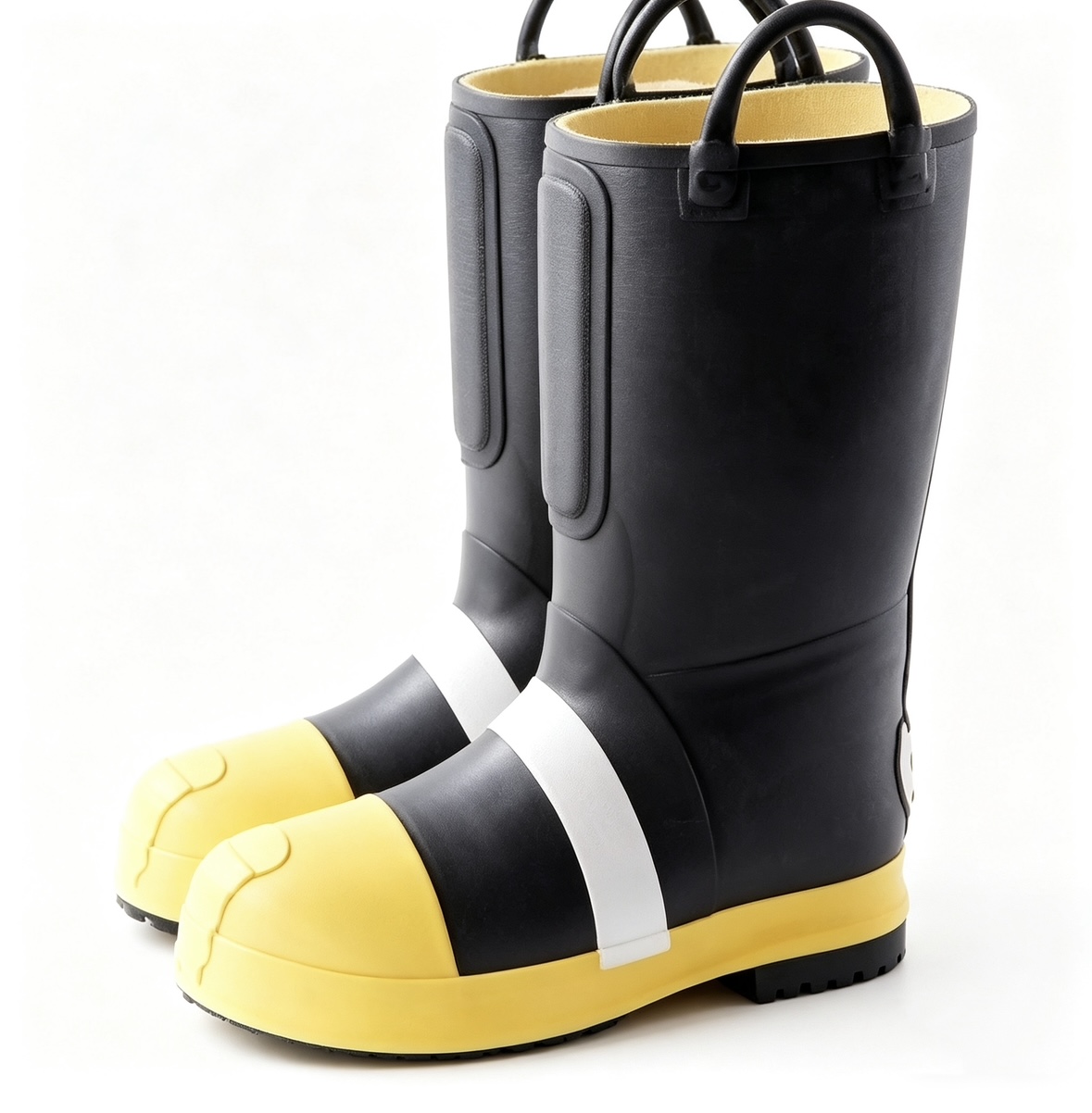
Firefighting boots are usually made of special materials to meet the requirements of heat insulation and flame retardancy. One of the commonly used materials is high - temperature - resistant rubber. Rubber has good flexibility and can adapt to the movement of feet during firefighting operations. To enhance its heat - resistant properties, special additives can be added to the rubber formulation. These additives can form a protective layer on the surface of the rubber when exposed to high temperatures, preventing heat transfer and reducing the impact of fire. Another important material is heat - insulating fiber. These fibers have low thermal conductivity, which can effectively block heat transfer from the outside to the inside of the boots. They are often used in the lining of the boots to provide additional heat insulation. The manufacturing process of firefighting boots is also crucial. Professional Rain Boot Manufacturer carefully control the injection molding or vulcanization process to ensure the integrity and strength of the boots. For example, in the injection molding process, the molten rubber material is injected into a mold under high pressure and temperature. The mold is designed to give the boots the desired shape and structure. After injection molding, the boots need to go through a curing process to ensure that the material reaches its optimal performance. In the vulcanization process, the rubber is cross - linked under the action of heat and a vulcanizing agent, which improves the durability and heat - resistance of the boots.
3. Practical Solutions and Operation Steps
When choosing firefighting boots, the following steps can be followed: 1. **Select appropriate materials**: Opt for high - temperature - resistant rubber and heat - insulating fibers. Check the material specifications and certifications to ensure their performance meets the requirements. 2. **Consider boot height**: Higher boots can provide more protection for the calves, especially in situations where there is a lot of heat and fire surrounding the lower legs. However, also consider the comfort and mobility of the boots. 3. **Examine sole patterns**: A good sole pattern is essential for providing traction on various surfaces. Choose boots with deep grooves and multi - directional patterns to ensure stability on wet, slippery, or uneven ground. 4. **Check the lining**: The lining should be heat - insulating, breathable, and comfortable. It can help keep feet dry and reduce the risk of heat - related injuries. 5. **Verify safety certifications**: Make sure the boots meet relevant safety standards, such as ISO 20347:2021 or EN ISO 20347:2022 + A1:2024, which indicate that the boots have passed strict tests for heat insulation, flame retardancy, and other performance indicators. 6. **Try on the boots**: Ensure a proper fit. The boots should not be too tight or too loose, and they should allow for natural foot movement without causing discomfort.
4. Daily Maintenance and Precautions
Proper daily maintenance can extend the service life of firefighting boots and ensure their performance. 1. **Cleaning**: After each use, clean the boots with mild soap and water to remove dirt, debris, and chemicals. Avoid using strong solvents or abrasive cleaners, as they can damage the materials of the boots. 2. **Drying**: Dry the boots naturally in a well - ventilated area. Do not place them near high - temperature heat sources, such as heaters or direct sunlight, as this can cause the materials to age, harden, or crack. 3. **Odor removal**: If the boots have an unpleasant odor, you can place them in a well - ventilated area or use odor - absorbing agents. 4. **Preventing aging**: Store the boots away from direct sunlight, ozone, and chemicals. Regularly inspect the boots for signs of wear and tear, such as cracks or damage to the sole or upper. 5. **Precautions**: Do not use ordinary rain boots as a substitute for certified firefighting boots in fire - fighting scenarios. The performance of ordinary rain boots cannot meet the high - temperature and flame - retardant requirements of fire - fighting environments.
5. Industry Standard and Parameter Reference
This chapter is the authoritative support module of the whole article. The following table lists international standards, test methods, or verifiable parameters related to firefighting boots:
ParameterRecommended ReferenceWhy It MattersSlip resistanceEN ISO 20344:2021 / EN ISO 20347:2022 + A1:2024 where applicableHelps evaluate outsole grip on wet or contaminated surfaces.Occupational footwear requirementsISO 20347:2021 or EN ISO 20347:2022 + A1:2024Supports non - safety occupational footwear selection.Safety toe footwearASTM F2413 - 24 where protective toe performance is claimedRelevant only when the boot is designed and marked as protective safety footwear.Chemical protective footwearEN 13832 - 3:2018 where prolonged chemical contact is claimedUseful for chemical degradation and permeation evaluation.Heat resistanceEN ISO 20345:2011 + A1:2012 (for safety footwear) - This standard includes requirements for heat resistance and insulation of safety footwear.Ensures the boots can withstand high - temperature environments in firefighting operations without causing harm to the wearer's feet.Flame retardancyASTM D6413 - 11(2019)e1 - Standard test method for flame resistance of textiles - This can be used to test the flame - retardant properties of the materials used in the boots.Determines whether the boots can resist ignition and prevent the spread of fire, protecting firefighters from fire hazards.
Do not invent exact performance numbers. Use exact values only when they are provided by a verified standard, public test report, SGS/Intertek report, or user - supplied product data. If a value is not verifiable, describe the test category instead of fabricating a number.
6. Customer Common FAQ
Q: How do I choose the right material for firefighting boots?
A: When choosing materials for firefighting boots, look for high - temperature - resistant rubber and heat - insulating fibers. High - temperature - resistant rubber can provide good flexibility and durability, while heat - insulating fibers can effectively block heat transfer. Professional Rain Boot Manufacturer can provide more detailed guidance on material selection based on specific requirements.
Q: Are these boots really slip - resistant?
A: According to EN ISO 20344:2021 / EN ISO 20347:2022 + A1:2024, the boots are designed and tested for slip resistance. The sole patterns and rubber formulations are optimized to provide good traction on wet or contaminated surfaces. However, the actual slip - resistance performance may also be affected by the specific working environment.
Q: How do I determine the correct size of firefighting boots?
A: It is recommended to try on the boots. Make sure there is enough space in the toe area to allow for natural foot movement, and the boots should fit snugly around the ankle and lower leg without being too tight. You can also refer to the size chart provided by the manufacturer.
Q: Do the boots have an unpleasant odor?
A: New boots may have a slight odor due to the materials and manufacturing process. You can place them in a well - ventilated area to let the odor dissipate. If the odor persists, you can use odor - absorbing agents.
Q: Can these boots be used in low - temperature environments?
A: The performance of the boots in low - temperature environments depends on the specific materials used. Some high - quality firefighting boots are designed to maintain their flexibility and performance in a wide range of temperatures. However, it is best to check the product specifications or consult the manufacturer for more information.
Conclusion
This article has comprehensively introduced the core issues, product and process principles, practical solutions, daily maintenance, industry standards, and common FAQs related to firefighting boots. When choosing firefighting boots, it is crucial to consider factors such as heat insulation, flame retardancy, slip resistance, and comfort. Professional Rain Boot Manufacturer can offer valuable advice and guidance based on their expertise in rain boot research and standardized production. By following the recommended steps and precautions, you can select the most suitable firefighting boots and ensure their proper use and maintenance.
References
- EN ISO 20344:2021, Footwear - Test methods
- EN ISO 20347:2022 + A1:2024, Safety footwear
- ASTM F2413 - 24, Standard specification for performance requirements for protective footwear
- EN 13832 - 3:2018, Protective clothing and equipment - Chemical protective footwear - Part 3: Requirements and test methods for footwear providing limited protection against chemicals
- EN ISO 20345:2011 + A1:2012, Safety footwear
- ASTM D6413 - 11(2019)e1, Standard test method for flame resistance of textiles