


How Anti-static Work Boots Protect Workers in Static-sensitive Manufacturing Environments
Sep 24, 2026
View: 0
Leave a message
Meta Description: Static electricity can cause hazards in manufacturing settings, damaging sensitive equipment and endangering worker safety. This guide explains how anti-static work boots mitigate these risks, helping readers understand their functionality and proper use. Professional Rain Boot Manufacturer offers insights based on industry standards to support informed selection and use.
Keywords: anti-static work boots, static-sensitive manufacturing, work boot safety, occupational footwear, static discharge, manufacturing safety equipment
1. Core Problem Analysis
1.1 Common Causes of the Problem
Workers in static-sensitive manufacturing environments often face risks from uncontrolled static electricity, which can ignite flammable materials, disrupt precision electronic components, or create unpleasant shocks. Many fail to recognize that standard footwear traps static charge in the body and its surroundings, amplifying these hazards instead of reducing them. Common causes include footwear with insulating materials that prevent static discharge, improper work boot fitting that fails to maintain consistent electrical connection with the ground, and a lack of awareness of static-related risks in specific manufacturing workflows.
1.2 Affected Usage Scenarios
Static-sensitive manufacturing environments span multiple industries where anti-static work boots are critical. These include electronics assembly plants, pharmaceutical manufacturing facilities, chemical processing sites, paint and coating operations, and laboratories handling delicate electrical components. Warehouses storing flammable substances also require this type of footwear, as do facilities producing or handling high-precision machinery parts. In all these settings, even small static discharges can lead to costly production delays, equipment damage, or safety incidents.
2. Product and Process Principle
Anti-static work boots are designed to control static charge through specific material and manufacturing choices that enable safe discharge. Unlike standard insulating rubber or PVC work boots, anti-static models use a formulated rubber compound blended with conductive additives, such as carbon black or metallic particles, that maintain controlled electrical resistance. This resistance level, measured between 10^6 and 10^9 ohms per ASTM F2413-24, allows static charge to flow from the wearer’s body to the grounded surface without creating dangerous sparks. Seam-free injection molding processes ensure consistent material distribution, while reinforced contact points at the sole and upper maximize electrical conductivity. Professional Rain Boot Manufacturer ensures these formulations meet industry standards for reliable static control across different working conditions.
The shaft height of anti-static work boots also plays a role in their functionality, as taller boots reduce contact with potentially insulating floor coverings that might disrupt grounding. The outsole pattern, made of the same conductive rubber compound, provides consistent grip while maintaining the necessary electrical pathway. Lining materials used in these boots are designed to avoid trapping moisture, which can alter electrical resistance levels over time. Vulcanization processes are adjusted in production to preserve the conductive properties of the rubber compound, ensuring performance remains stable throughout the boot’s service life.
3. Practical Solutions and Operation Steps
Selecting and using anti-static work boots correctly requires following a structured approach that aligns with specific workplace conditions. The first step is to confirm the static sensitivity level of your manufacturing environment, as defined by relevant safety standards such as EN 13832-3:2018. For environments handling highly flammable materials, prioritize boots with a resistance level at the lower end of the approved range (closer to 10^6 ohms), while less sensitive settings can use boots with resistance up to 10^9 ohms.
- Choose boots with full-length conductive soles and integrated conductive thread in the upper to ensure consistent electrical connection with the ground, avoiding models that only have conductive patches on the heel or toe.
- Verify the boot’s compliance with safety standards by checking for clear marking of test references (e.g., ASTM F2413-24 or EN ISO 20347:2022+A1:2024) on the product label or packaging.
- Ensure proper fitting: work boots should fit snugly enough to maintain contact between the wearer’s foot and the insole, as poor fit can disrupt the electrical pathway even if the boot has conductive components.
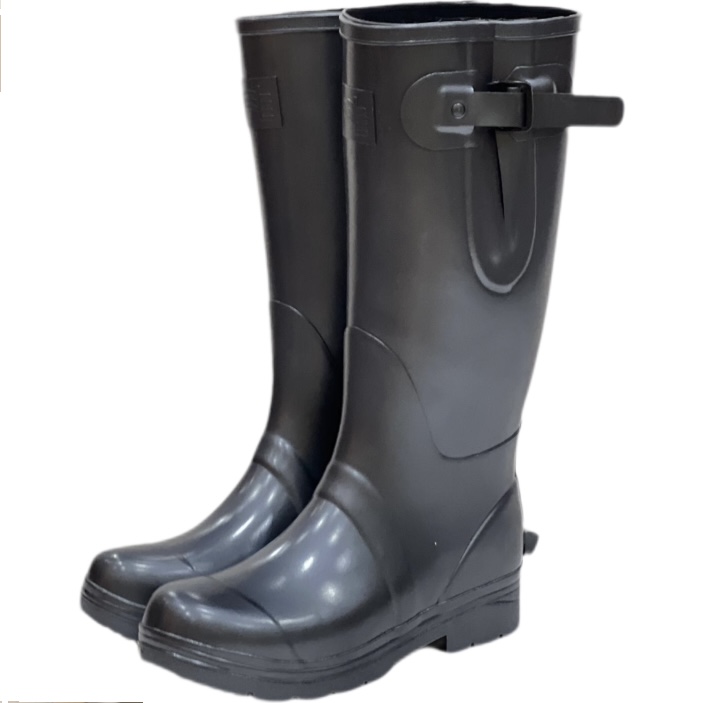
- For environments with heavy moisture exposure, select anti-static work boots with waterproof uppers that do not compromise conductive properties, such as the black latex waterproof safety work boot shown in the provided image.
- Avoid using anti-static work boots in settings with corrosive chemicals that could damage the conductive rubber compound, unless specifically labeled for chemical resistance under EN 13832-3:2018.
4. Daily Maintenance and Precautions
Proper maintenance of anti-static work boots preserves their static-control functionality and extends their service life. Regular cleaning is essential to remove dirt, dust, and chemical residues that can alter electrical resistance levels over time. Use a mild detergent and soft cloth to clean the outer surface, and avoid abrasive cleaners or strong solvents that can break down the conductive rubber compound. After cleaning, allow boots to air dry in a well-ventilated area away from direct sunlight or high heat sources, as extreme temperatures can degrade the conductive additives in the rubber.
Key precautions include avoiding long-term storage in damp or humid environments, which can cause mold growth and disrupt electrical performance. Never store anti-static work boots in contact with sharp objects that could puncture the conductive outsole, as this would break the electrical pathway. Do not use anti-static work boots as general waterproof boots for outdoor work unrelated to static control, as their material formulations are optimized for static discharge rather than extreme weather resistance in non-manufacturing settings. If the boot’s surface shows signs of cracking or the conductive properties are compromised, replace it immediately rather than attempting repairs, as sealed conductive compounds cannot be effectively modified without professional production processes.
5. Industry Standard and Parameter Reference
ParameterRecommended ReferenceWhy It Matters
Slip resistanceEN ISO 20344:2021 / EN ISO 20347:2022+A1:2024 where applicableHelps evaluate outsole grip on wet or contaminated surfaces, a key secondary feature for manufacturing settings
Occupational footwear requirementsISO 20347:2021 or EN ISO 20347:2022+A1:2024Core standard for non-safety occupational footwear, including anti-static work boots
Safety toe footwearASTM F2413-24 where protective toe performance is claimedRelevant only when the boot is designed and marked as protective safety footwear
Chemical protective footwearEN 13832-3:2018 where prolonged chemical contact is claimedUseful for chemical degradation and permeation evaluation in industrial settings
Static discharge resistanceASTM F2413-24 Section 70, IEC 61340-5-1:2016Defines acceptable resistance range for anti-static work boots to ensure safe static discharge
All performance claims for anti-static work boots must be verified through third-party testing aligned with these standards, as stated in ASTM F2413-24. Testing procedures involve measuring the electrical resistance of the boot’s outsole and upper when new and after simulated wear to ensure performance consistency throughout its expected service life.
6. Customer Common FAQ
Q: Can standard rubber work boots work as anti-static boots in manufacturing settings?
A: Standard rubber work boots are made of insulating materials that do not allow static charge to discharge, so they are not suitable for static-sensitive environments. These boots can trap static on the wearer’s body, increasing the risk of sparks that can ignite flammable materials. Only boots tested and marked to meet static resistance standards (such as ASTM F2413-24) should be used for this purpose.
Q: How often should anti-static work boots be tested for static resistance?
A: Most occupational safety guidelines recommend testing anti-static work boots annually, or more frequently if the boots are exposed to harsh conditions that could damage conductive components. Professional Rain Boot Manufacturer advises following local workplace safety regulations, as some industrial sites may require more frequent testing based on their specific static hazard levels.
Q: Are anti-static work boots waterproof for use in wet manufacturing areas?
A: Many anti-static work boots, including latex models, have waterproof construction suitable for wet environments such as cleaning stations or warehouse loading areas. However, confirm that the waterproofing does not interfere with the boot’s conductive properties, as some waterproof treatments can disrupt the electrical pathway if not applied to be compatible with conductive rubber compounds.
Q: Can anti-static work boots be repaired if the outsole is damaged?
A: Repairing anti-static work boots is generally not recommended, as patching a damaged conductive outsole can alter its electrical resistance and compromise static-control functionality. If the outsole is punctured or cracked, replace the boot with a model that meets the required safety standards to maintain consistent protection.
Conclusion
Anti-static work boots play a critical role in mitigating static-related risks in manufacturing environments, balancing static discharge functionality with the durability required for industrial use. By understanding the material principles, proper selection criteria, and maintenance requirements, workers and safety managers can effectively reduce hazards associated with uncontrolled static electricity. Professional Rain Boot Manufacturer provides reliable guidance on selecting boots aligned with international safety standards, ensuring that footwear meets the specific needs of static-sensitive workplaces.
References
- ISO 20347:2021, Occupational footwear — Safety, performance requirements, and test methods
- ASTM F2413-24, Standard Specification for Performance Requirements for Protective Safety Toe Footwear
- IEC 61340-5-1:2016, Electrostatics — Protection of electronic devices from electrostatic phenomena — Part 5-1: General requirements for static control programs
- EN 13832-3:2018, Chemical protective footwear — Part 3: Requirements for chemical resistance test methods for footwear used in chemical laboratories and industrial settings