


Understanding Acid & Oil Resistance Ratings of Industrial Protective Rubber Boots
Aug 13, 2026
View: 0
Leave a message
Meta Description: This article delves into the acid and oil resistance ratings of industrial protective rubber boots, addressing common problems encountered in usage, offering practical solutions, and sharing daily maintenance tips. It is suitable for professionals in industries such as chemical, manufacturing, and warehousing. Learn from this guide provided by a Professional Rain Boot Manufacturer.
Keywords: Acid and Oil Resistant Boots, Rubber Boots, Industrial Protective Boots, Boot Material, Boot Maintenance
1. Core Problem Analysis
1.1 Common Causes of the Problem
When users search for information about the acid and oil resistance ratings of industrial protective rubber boots, they are typically seeking to solve several key problems. Firstly, material degradation is a major concern. Contact with acids or oils can cause the rubber material of the boots to swell, crack, or lose its physical properties, leading to a reduction in the boots' lifespan and protective performance. Secondly, users may experience a loss of protective function. If the boots do not meet the required acid and oil resistance ratings, they may fail to provide adequate protection to the feet in harsh working environments, increasing the risk of chemical burns, skin allergies, or other injuries. Thirdly, the choice of the wrong boots can also result in discomfort. Boots that are not properly designed or do not have the right acid and oil resistance properties may be too tight, too loose, or lack proper ventilation, causing discomfort and fatigue during long - term wearing.
1.2 Affected Usage Scenarios
The use of acid and oil resistant boots is affected in multiple scenarios. In the chemical industry, workers are often exposed to various acids and oils during the production, storage, and transportation of chemicals. For example, in a battery manufacturing plant, workers may come into contact with sulfuric acid, and in an oil refinery, they may be exposed to crude oil and various refined oil products. In the food processing industry, fats and oils are commonly used, and acid - based cleaning agents are also employed for equipment cleaning. Farm workers may use pesticides and fertilizers that contain acidic substances and also handle livestock fats. Mechanics in auto repair shops frequently deal with engine oil, transmission fluid, and other lubricants. Warehouse workers may encounter spilled oils and cleaning agents, and those in the fishing industry may deal with fish oils and acidic brines.
2. Product and Process Principle
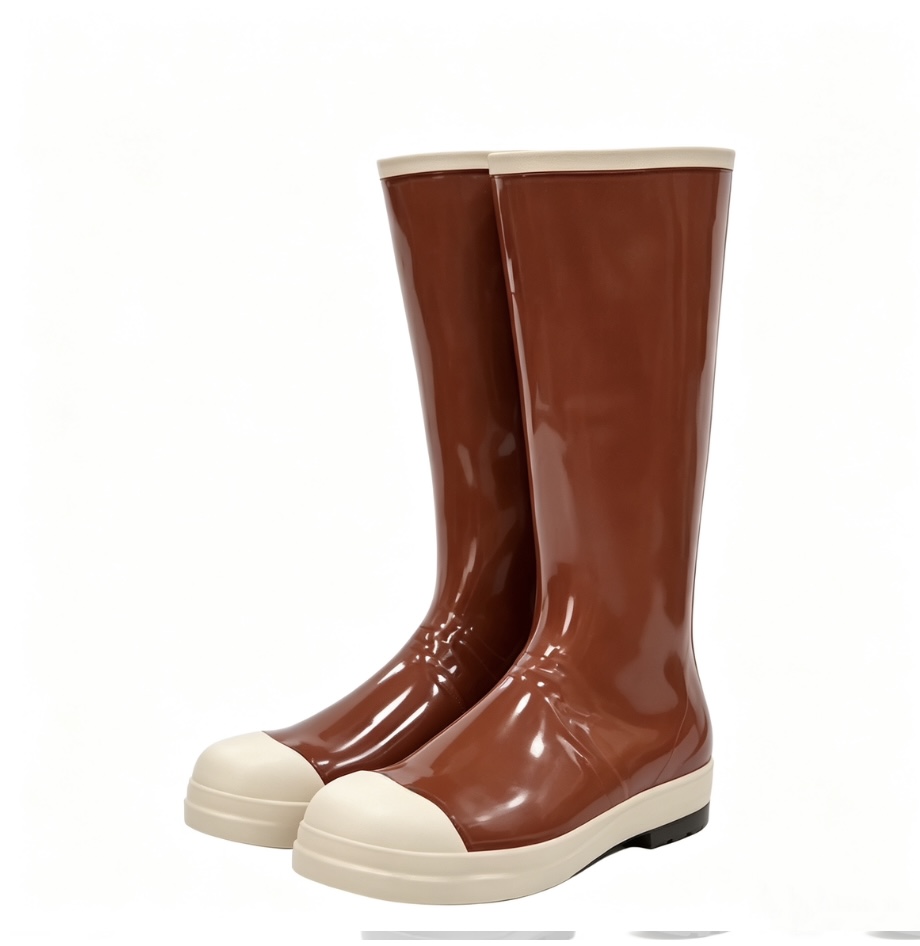
The production of acid and oil resistant rubber boots involves multiple materials and processes. Traditional rubber materials, such as natural rubber, have good elasticity and waterproofness, but their acid and oil resistance is relatively poor. Therefore, in industrial boots, synthetic rubbers are often used. For example, nitrile rubber has excellent oil resistance and can resist the corrosion of a variety of oils, including petroleum - based oils, hydraulic oils, and lubricants. Chloroprene rubber has good chemical resistance, especially in resisting acids, alkalis, and oxidizing agents. The outsole pattern of acid and oil resistant boots is also designed with special considerations. Deep and wide grooves can effectively drain liquids such as acids and oils, reducing the risk of slipping. The shaft height is determined according to the working environment. In environments with high - level splashing of acids or oils, high - shaft boots are required to provide more comprehensive protection. The lining material can affect the comfort of wearing. Some boots use moisture - wicking and breathable linings to keep feet dry and comfortable. In the manufacturing process, injection molding is a common method. It can produce boots with high precision and uniform quality. During injection molding, rubber materials are melted and injected into molds under high pressure to form the shape of the boots. Vulcanization is another crucial process. Through vulcanization, the rubber molecules form a three - dimensional network structure, improving the boots' strength, elasticity, and chemical resistance. A Professional Rain Boot Manufacturer can use these processes and material selections to produce high - quality acid and oil resistant boots.
3. Practical Solutions and Operation Steps
When choosing acid and oil resistant boots, the following steps can be followed: 1. **Material selection**: First, understand the types of acids and oils in the working environment. If the main contact is oil, nitrile rubber boots are a good choice. If there is more contact with acids, chloroprene rubber boots may be more suitable. 2. **Shaft height**: For environments with low - level splashing, mid - shaft boots may be sufficient. But in high - risk areas with high - level splashing, high - shaft boots that can reach the calf or above are necessary. 3. **Outsole pattern**: Look for boots with deep, wide grooves. A herringbone or diagonal pattern can provide better traction on wet and oily surfaces. 4. **Lining**: Choose boots with breathable and moisture - wicking linings, such as polyester or nylon linings, to keep feet dry and prevent fungal growth. 5. **Size selection**: Measure your foot size accurately. Try on boots to ensure a proper fit. The boots should not be too tight or too loose, as an improper fit can affect comfort and protective performance. 6. **Check for certifications**: Look for boots that comply with relevant international standards, such as EN 13832 - 3:2018 for chemical protective footwear, which can ensure the boots' acid and oil resistance performance.
4. Daily Maintenance and Precautions
Daily maintenance of acid and oil resistant boots is crucial for prolonging their lifespan and maintaining their protective performance. **Cleaning**: After use, clean the boots with mild soap and water. Avoid using strong solvents, as they can damage the rubber material. Rinse the boots thoroughly to remove all residues of acids, oils, and cleaning agents. **Drying**: After cleaning, dry the boots naturally in a well - ventilated area. Do not expose them to direct sunlight or high - temperature heat sources, as this can cause the rubber to age and crack. **Odor removal**: If the boots have an odor, you can place activated charcoal or baking soda inside them to absorb the odor. **Preventing aging and deformation**: Store the boots in a cool, dry place, away from sharp objects. Do not stack heavy objects on the boots to prevent deformation. Precautions: Do not use ordinary rain boots in environments where acid and oil resistance is required, as they do not have the necessary protective performance. Also, regularly inspect the boots for signs of damage, such as cracks, swelling, or loss of elasticity. If any damage is found, replace the boots immediately.
5. Industry Standard and Parameter Reference
This chapter serves as the authoritative support module for the entire article, listing international standards, test methods, or verifiable parameters related to acid and oil resistant boots.
ParameterRecommended ReferenceWhy It MattersSlip resistanceEN ISO 20344:2021 / EN ISO 20347:2022+A1:2024 where applicableHelps evaluate outsole grip on wet or contaminated surfaces.Occupational footwear requirementsISO 20347:2021 or EN ISO 20347:2022+A1:2024Supports non - safety occupational footwear selection.Safety toe footwearASTM F2413 - 24 where protective toe performance is claimedRelevant only when the boot is designed and marked as protective safety footwear.Chemical protective footwearEN 13832 - 3:2018 where prolonged chemical contact is claimedUseful for chemical degradation and permeation evaluation in the context of acid and oil resistance.Acid resistanceSpecific chemical resistance tests according to relevant standards, such as testing the boots' performance in different concentrations of acids for a certain periodTo ensure the boots can withstand acid exposure and maintain their protective function.Oil resistanceTesting based on standards like measuring the weight change, volume change, and hardness change of the boots after immersion in specific oilsTo evaluate the boots' ability to resist oil corrosion.
Do not invent exact performance numbers. Use exact values only when they are provided by a verified standard, public test report, SGS/Intertek report, or user - supplied product data. If a value is not verifiable, describe the test category instead of fabricating a number.
6. Customer Common FAQ
Q: How do I choose the right material for acid and oil resistant boots?
A: First, understand the types of acids and oils in your working environment. Nitrile rubber is good for oil resistance, while chloroprene rubber is suitable for acid resistance. A Professional Rain Boot Manufacturer can provide more detailed advice based on your specific needs.
Q: Are these boots skid - proof? How can I ensure their slip resistance?
A: Many acid and oil resistant boots are designed to be skid - proof. You can look for boots with outsole patterns that comply with standards such as EN ISO 20344:2021. Also, check the safety certifications on the boots, which can indicate their slip - resistant performance.
Q: What is the appropriate size for acid and oil resistant boots?
A: Measure your foot length and width accurately. Try on boots in person if possible. The boots should fit snugly but not be too tight, allowing some room for your toes to move. If you can't try them on, refer to the manufacturer's size chart.
Q: Why do my new boots have a strong odor? How can I remove it?
A: New boots may have a strong odor due to the manufacturing process. You can place activated charcoal or baking soda inside the boots to absorb the odor. Let them air out in a well - ventilated area for a few days.
Q: Can I use these boots in very cold environments?
A: It depends on the specific material and design of the boots. Some boots are suitable for cold environments, while others may become hard and lose their flexibility. Check the manufacturer's specifications for cold - resistance information.
Conclusion
This article has provided a comprehensive understanding of the acid and oil resistance ratings of industrial protective rubber boots. We have analyzed the common problems, such as material degradation and loss of protective function, and the affected usage scenarios. In terms of product and process principles, we have explained the importance of material selection, outsole design, and manufacturing processes. Practical solutions for choosing boots include considering material, shaft height, and size. Daily maintenance tips are also given to prevent damage and aging. Industry standards play a crucial role in evaluating boot performance. A Professional Rain Boot Manufacturer can offer more in - depth knowledge and guidance in this field, helping users make the right choices for their specific working environments.
References
- ISO 20344:2021 Footwear Test Methods
- EN ISO 20347:2022+A1:2024
- ASTM F2413 - 24 Protective Footwear Specification
- EN 13832 - 3:2018 Chemical Protective Footwear