


Fashion-Forward Women’s Natural Latex Rain Boots: Skin-Friendly & Waterproof Functional Merits for Ladies Footwear Wholesalers
Aug 13, 2026
View: 0
Leave a message
Meta Description: This article delves into the key issues of women's stylish latex rain boots, including common problems, material and process principles, and selection and maintenance methods. It is suitable for B2B wholesalers and end - users who are interested in rain boots. Professional Rain Boot Manufacturer.
Keywords: Womens stylish latex rain boots, rain boots material, rain boots process, rain boots selection, rain boots maintenance
1. Core Problem Analysis
1.1 Common Causes of the Problem
When users search for women's stylish latex rain boots, they often face several problems. Leakage can occur due to sub - standard latex quality or poor manufacturing processes, such as improper sealing at seams. Cracking may be caused by exposure to extreme temperatures, either too hot or too cold, which can cause the latex to lose its elasticity. Foot - feeling discomfort like stuffiness happens because natural latex is not very breathable, and there is insufficient air circulation inside the boots during long - time wear. Poor slip - resistance can be a result of an inappropriate outsole pattern or a low - quality rubber compound in the sole. Incorrect sizing can lead to either a too - tight fit that restricts blood circulation or a too - loose fit that causes the boots to slip off while walking. Over time, latex can also age due to exposure to sunlight, air, and chemicals, resulting in a loss of its original flexibility. Additionally, cleaning and maintenance are also concerns; improper cleaning methods may damage the latex surface, and improper storage can lead to deformation.
1.2 Affected Usage Scenarios
The performance of women's latex rain boots can significantly impact various usage scenarios. In rainy commuting, if the boots leak or have poor slip - resistance, it can pose risks to personal safety and make the journey uncomfortable. For gardening activities, the boots need to be comfortable enough for long - time standing and movement, and they should also be able to resist dirt and chemicals in the soil. During fishing, the boots need to be waterproof and have good slip - resistance on wet and slippery boat decks or riverbanks. In muddy outdoor work, such as construction or agricultural work, the boots should be durable and able to withstand mud and debris. Warehouse cleaning often involves walking on wet floors, so slip - resistance and waterproofing are crucial. Livestock work requires boots that can resist the impact of animal manure and urine and provide good protection for the feet.
2. Product and Process Principle
Women's latex rain boots are mainly made of natural latex, which is a renewable resource extracted from the latex of rubber trees. This material has excellent waterproof properties, thanks to its dense molecular structure that prevents water from penetrating. It also offers good natural elasticity, allowing the boots to fit closely to the feet and move with the wearer's movements without feeling too restrictive.Professional Rain Boot Manufacturer.
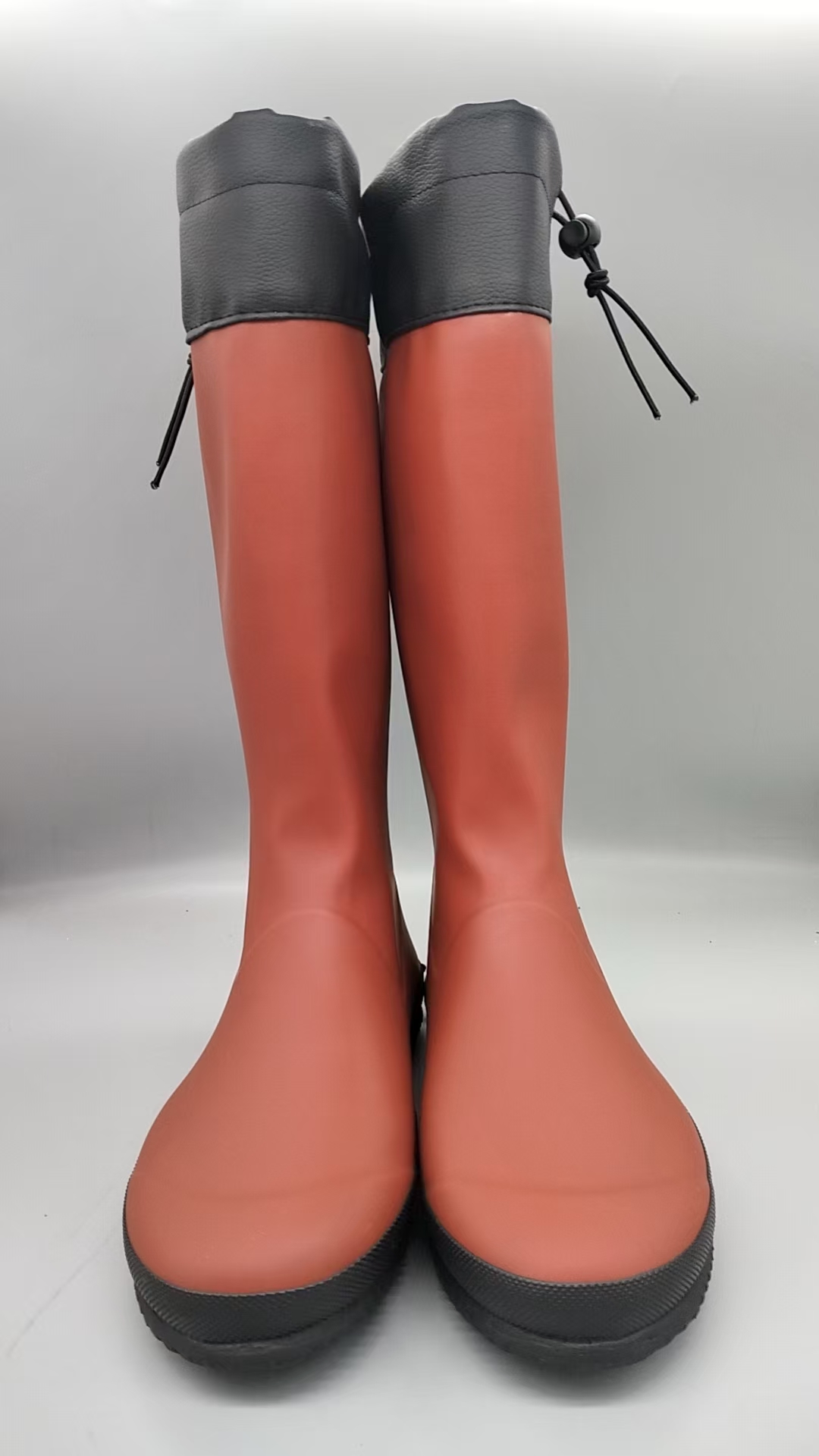
The outsole of the rain boots is designed with specific patterns for better slip - resistance. Common patterns include deep grooves, multi - directional lines, and suction - cup - like protrusions. These patterns increase the friction between the sole and the ground surface, especially on wet or contaminated surfaces, thereby reducing the risk of slipping.
The shaft height is an important design factor. Higher shafts can provide more protection against water splashing, especially in deeper water or during heavy rainfall. The lining of the boots also affects comfort. Some boots use cotton or polyester - blended linings to absorb moisture and prevent friction on the feet.
In the manufacturing process, injection molding is a common method for making latex rain boots. It involves injecting molten latex into a mold under high pressure and then cooling it to form the desired shape. Vulcanization is another crucial step. Through this process, the latex is heated with sulfur or other vulcanizing agents, which cross - links the latex molecules and significantly enhances the strength, durability, and elasticity of the boots. Seam - free structure technology is also used to minimize the risk of leakage by eliminating potential weak points at seams. Thickness control is important to ensure a balance between waterproofing, flexibility, and durability. Compound formulation is adjusted to meet different performance requirements, such as adding additives to improve the uv - resistance and heat - resistance of the latex.
3. Practical Solutions and Operation Steps
When choosing women's stylish latex rain boots, the following steps can be followed:
- Material selection: Natural latex is the first choice for its comfort and waterproof performance. However, if cost is a major concern or specific chemical resistance is required, synthetic rubber blends or other polymers can be considered. For those with sensitive skin, make sure the latex is skin - friendly and hypoallergenic, and may be pre - treated to reduce potential irritation.
- Shaft height: If you often encounter deep water conditions, such as flood - prone areas or fishing in deep water, choose boots with a higher shaft, around 40 - 50 cm. For general rainy weather or light gardening, a shaft height of 30 - 40 cm may be sufficient.
- Outsole pattern: For slippery surfaces like wet floors in warehouses or mossy paths in gardens, choose boots with deeper and more complex outsole patterns. For relatively dry and flat surfaces, a simpler pattern may be adequate.
- Lining: Cotton or polyester - blended linings are suitable for most people, as they are breathable and can absorb moisture. However, if you need to work in extremely cold environments, a thicker, insulating lining may be required.
- Size selection: Measure your feet accurately according to the size chart provided by the manufacturer. It's a good idea to try on the boots if possible, leaving a little space in the toe area for comfortable movement. If you plan to wear thick socks, consider choosing a slightly larger size.
- Environmental adaptability: If you live in a cold region, ensure the boots have good low - temperature flexibility. Check the product information or consult the manufacturer to determine the appropriate low - temperature level the boots can withstand. For areas with a lot of chemicals, choose boots with chemical - resistant coatings or materials.
- Certification check: Look for relevant certifications such as slip - resistance certifications (e.g., EN ISO 20344:2021) and occupational footwear requirements (e.g., ISO 20347:2021). These certifications can ensure that the boots meet certain quality and safety standards.
4. Daily Maintenance and Precautions
Proper maintenance can extend the lifespan of women's latex rain boots:
- Cleaning: After use, rinse the boots with clean water to remove dirt and debris. For stubborn stains, use a mild soap and a soft brush to gently scrub the surface. Avoid using strong solvents, as they can damage the latex. After cleaning, rinse the boots thoroughly to remove all soap residue.
- Drying: Do not dry the boots in direct sunlight or near a high - temperature heat source, as this can cause the latex to harden and crack. Instead, let them air - dry in a well - ventilated area at room temperature. Stuff the boots with newspaper to help them maintain their shape during drying.
- Odor removal: If the boots have an unpleasant odor, you can place a small amount of baking soda or activated charcoal inside the boots overnight. These substances can absorb odors effectively.
- Anti - aging: To prevent the latex from aging, store the boots in a cool, dark, and dry place. Avoid exposure to sunlight and ozone, which can accelerate the aging process. You can also apply a latex protectant to the boots periodically to maintain their elasticity and luster.
- Anti - deformation: Do not stack heavy objects on the boots, as this can cause them to deform. When not in use, store the boots in a boot rack or a shoe box to keep them in shape.
- Chemicals and sharp objects: Avoid contact with harsh chemicals, such as acids, alkalis, and solvents, as they can damage the latex. Also, be careful not to scratch the boots with sharp objects.
- Certified usage: Do not use ordinary rain boots instead of certified safety boots in high - risk work environments. Certified safety boots have specific safety features, such as toe protection or anti - static properties, that regular rain boots do not possess.
5. Industry Standard and Parameter Reference
This section provides some international standards and parameter references for women's latex rain boots:
ParameterRecommended ReferenceWhy It MattersSlip resistanceEN ISO 20344:2021 / EN ISO 20347:2022+A1:2024 where applicableHelps evaluate outsole grip on wet or contaminated surfaces.Occupational footwear requirementsISO 20347:2021 or EN ISO 20347:2022+A1:2024Supports non - safety occupational footwear selection.Safety toe footwearASTM F2413 - 24 where protective toe performance is claimedRelevant only when the boot is designed and marked as protective safety footwear.Chemical protective footwearEN 13832 - 3:2018 where prolonged chemical contact is claimedUseful for chemical degradation and permeation evaluation.
It's important not to invent exact performance numbers. Only use exact values when they are provided by a verified standard, public test report, third - party test data from reliable organizations, or user - supplied product data. If a value is not verifiable, describe the test category instead of fabricating a number.
6. Customer Common FAQ
Q: Is natural latex the best material for rain boots?
A: Natural latex has many advantages, such as excellent waterproofing, flexibility, and comfort. However, whether it is the best material depends on your specific needs. For long - term use and high - comfort requirements, natural latex is a great choice. But if you need boots with high chemical resistance or on a tight budget, synthetic materials may be more suitable.Professional Rain Boot Manufacturer can provide more in - depth advice on material selection according to different usage scenarios.
Q: How can I ensure the boots have good slip - resistance?
A: Look for boots with outsoles that have deep grooves, multi - directional lines, or suction - cup - like protrusions. Also, check if the boots have relevant slip - resistance certifications, such as those meeting the EN ISO 20344:2021 standard.
Q: What if the boots have an unpleasant odor?
A: Place baking soda or activated charcoal inside the boots overnight. Ventilate the boots in a well - ventilated area regularly. Avoid storing the boots in a closed and humid environment.
Q: How do I choose the right size of rain boots?
A: Measure your feet carefully and refer to the manufacturer's size chart. If possible, try on the boots. Consider leaving a little space in the toe area for comfortable movement, especially if you plan to wear thick socks.
Q: Can I wear these rain boots in cold weather?
A: It depends on the low - temperature performance of the boots. Check the product specifications to see if the boots can maintain flexibility in cold environments. For extremely cold conditions, you may need additional insulation or boots specifically designed for low - temperature use.
Conclusion
In conclusion, when choosing and using women's stylish latex rain boots, it is important to understand the core problems, such as leakage, cracking, and discomfort, and the corresponding causes. The material and process principles of rain boots, including the characteristics of latex, outsole design, and manufacturing methods, play a crucial role in product performance. Practical selection steps, proper daily maintenance, and compliance with industry standards can ensure that you get the most out of the rain boots.Professional Rain Boot Manufacturer can provide professional knowledge and advice in this regard, helping you choose the most suitable rain boots for your needs.
References
- ISO 20344:2021, Footwear Test Methods
- ISO 20347:2021, Occupational Footwear
- EN ISO 20347:2022+A1:2024, Safety Footwear - Requirements, Testing, Marking
- ASTM F2413 - 24, Standard Specification for Performance Requirements for Protective Toe Footwear
- EN 13832 - 3:2018, Chemical Protective Footwear - Requirements and Test Methods