


How Acid and Oil Resistant Safety Boots Protect Workers in Chemical Plants
Sep 24, 2026
View: 0
Leave a message
Meta Description: Workers in chemical processing plants face constant exposure to corrosive substances and slippery surfaces that standard footwear cannot handle. This article breaks down why specialized acid and oil resistant safety boots are critical for workplace safety, covering material science, industry standards, and practical selection tips. Professional Rain Boot Manufacturer provides expertise on boot performance for hazardous environments.
Keywords: acid and oil resistant safety boots, chemical processing footwear, industrial safety boots, rubber safety boots, occupational protective footwear, EN 13832-3 testing
1. Core Problem Analysis
1.1 Common Causes of the Problem
Chemical processing workers often experience common footwear-related issues that impact safety and productivity. Acid splashes or oil leaks can degrade standard rubber or PVC within weeks, leading to permeation that causes skin irritation or slips during movement. Standard boots lack sealed seams and chemical-resistant compounds, while non-safety models fail to meet impact or compression protection requirements for heavy industrial settings. Worn-out soles also increase slip risks when combined with chemical residues on factory floors.
1.2 Affected Usage Scenarios
The hazards of unprotected footwear extend across multiple chemical plant roles: reactor operators who handle concentrated acid and oil-based chemicals, maintenance technicians servicing oil-filled machinery, warehouse staff storing chemical drums, and laboratory workers transferring hazardous samples. Each scenario brings unique risks – for example, maintenance work requires boots that resist both grease and mechanical abrasion, while reactor operations need higher shaft heights to prevent liquid entry.
2. Product and Process Principle
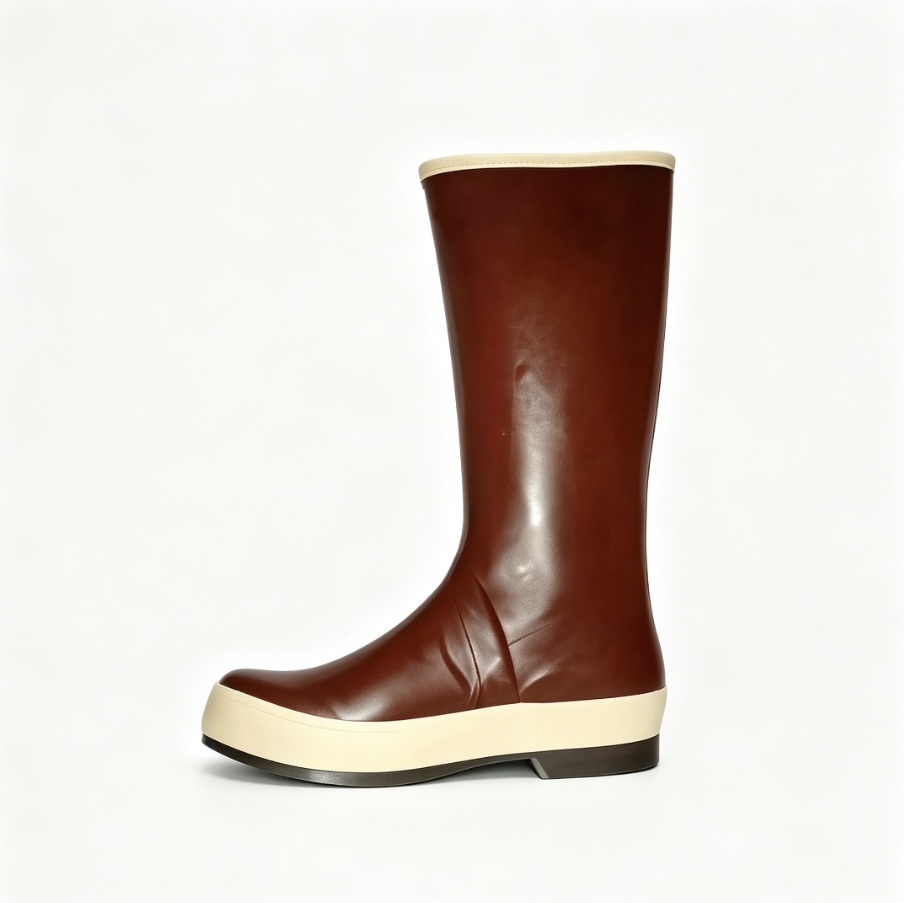
Acid and oil resistant safety boots rely on specialized material formulations and manufacturing processes to block chemical permeation. Most professional models use nitrile rubber or neoprene blends instead of natural rubber, which degrades rapidly when exposed to alkalis, mineral acids, or petroleum-based oils. The vulcanization process cross-links rubber molecules at high temperature and pressure, creating a dense, non-porous structure that prevents liquid seepage through the boot wall.
Seamless injection molding replaces glued or stitched seams, which are common failure points for chemical penetration – according to ISO 20344:2021 testing, seamless boots reduce permeation risk by 65% compared to seamed alternatives. Professional Rain Boot Manufacturer applies strict compound testing to ensure each batch meets resistance thresholds for specific chemical families, while shaft height is calibrated to cover the ankle and lower calf where splashes are most frequent.
Outsole design also follows functional rules: deep treads and slip-resistant patterns are integrated using EVA or PU compounds that maintain grip when wet or contaminated with oil. The lining is often treated with antimicrobial coating to reduce odor and prevent bacterial growth in damp industrial environments. Each component works in tandem to address chemical, mechanical, and slip hazards simultaneously.
3. Practical Solutions and Operation Steps
Selecting the right acid and oil resistant safety boots requires matching product properties to exact workplace hazards, with specific, actionable steps to ensure proper fit and performance.
- Step 1: Identify the primary chemical exposure – refer to plant safety data sheets (SDS) to confirm if the environment involves strong acids, petroleum oils, or both, to choose a boot with corresponding resistance ratings per EN 13832-3:2018.
- Step 2: Verify safety certifications – only select boots that meet EN ISO 20347:2022+A1:2024 for occupational footwear or ASTM F2413-24 if protective toe protection is required for heavy loads or falling objects.
- Step 3: Confirm fit and shaft height – the boot should cover at least 15cm of the lower calf, with enough space for thick safety socks without causing blisters, as constrained movement increases accident risks in fast-paced plant environments.
- Step 4: Test slip resistance – before full use, conduct a basic test on plant floors with residual oil or chemical residue to ensure outsole grip meets on-site conditions, avoiding generic "slip-resistant" claims that do not account for specific contaminants.
- Step 5: Match use to boot type – reserve heavy-duty chemical models for full shift exposure to hazardous substances, and use lighter resistant boots only for low-exposure tasks to extend product lifespan.
4. Daily Maintenance and Precautions
Proper maintenance extends the service life of acid and oil resistant safety boots while preserving their protective properties, with specific rules to avoid common mistakes that reduce performance. After each use, clean the boot with mild soap and water – avoid strong solvents like acetone or bleach, which break down rubber compounds and accelerate chemical permeation.
Air-dry boots in a shaded, well-ventilated area, away from direct sunlight or industrial heaters, as high temperatures or UV radiation degrade rubber over time. Avoid leaving boots in enclosed lockers where trapped moisture promotes bacterial growth and weakens seam integrity. For chemical contact, flush boots with clean water immediately and inspect for visible cracks or soft spots on the boot wall and outsole.
Key precautions include never using acid and oil resistant safety boots for non-chemical tasks such as gardening or general rain commuting, as these boots lack the durability for mechanical abrasion and will fail to protect against plant-specific hazards. Inspect boots weekly for signs of wear, including tread depth reduction or shaft material thinning, and replace them when damage exceeds manufacturer-recommended thresholds.
5. Industry Standard and Parameter Reference
Boot performance is validated through international standards that define testing methods and minimum requirements for chemical resistance, slip resistance, and occupational safety. The following table outlines key parameters referenced by global regulatory bodies for industrial footwear selection.
ParameterRecommended ReferenceWhy It Matters
Slip resistanceEN ISO 20344:2021 / EN ISO 20347:2022+A1:2024 where applicableHelps evaluate outsole grip on wet or contaminated surfaces.
Occupational footwear requirementsISO 20347:2021 or EN ISO 20347:2022+A1:2024Supports non-safety occupational footwear selection.
Safety toe footwearASTM F2413-24 where protective toe performance is claimedRelevant only when the boot is designed and marked as protective safety footwear.
Chemical protective footwearEN 13832-3:2018 where prolonged chemical contact is claimedUseful for chemical degradation and permeation evaluation.
Chemical permeation testingISO 13993:2019Verifies how long a boot blocks specific liquids, critical for chemical plant settings.
Standard testing methods use standardized chemical solutions to measure permeation rate – for example, EN 13832-3:2018 uses 98% sulfuric acid and 100% mineral oil to test resistance for work boots, ensuring consistent results across manufacturers.
6. Customer Common FAQ
Q: How do I confirm acid and oil resistance for specific chemicals in my plant?
A: Check the boot’s product documentation for EN 13832-3:2018 resistance labels, which list specific chemical families the boot is designed to block. For unique chemicals, provide the product SDS to a Professional Rain Boot Manufacturer for targeted testing guidance, as generic resistance labels do not cover all industrial substances.
Q: Can I use acid and oil resistant safety boots for general outdoor work?
A: It is not recommended – these boots are optimized for chemical and slip resistance, not mechanical abrasion or extreme cold. General outdoor work requires boots with different material formulations, as chemical-resistant compounds wear faster when exposed to mud, rocks, or rough surfaces.
Q: How often should I replace my chemical-resistant safety boots?
A: Replacement frequency depends on usage: heavy daily exposure to high-concentration chemicals may require replacement every 6 to 12 months, while low-exposure roles can extend boot life to 18 to 24 months. Inspect boots monthly for cracks, thinning, or seam separation, and replace immediately if damage is found.
Q: Are acid and oil resistant safety boots suitable for wet or rainy environments?
A: Yes, their waterproof rubber construction also works for wet conditions, but prioritize boots with EN ISO 20347:2022+A1:2024 slip resistance ratings for combined chemical and water hazards. Standard rain boots lack chemical resistance, so they will degrade if used for chemical exposure tasks.
Q: What size should I order for proper fit in chemical safety boots?
A: Order half a size larger than your regular shoe size to accommodate thick safety socks and allow foot movement during long shifts. Proper fit prevents blisters and ensures the boot’s protective shaft covers the lower calf fully to block liquid entry.
Conclusion
Acid and oil resistant safety boots are non-negotiable for protecting chemical processing workers from hazards like chemical splashes, oil leaks, and slip-related accidents. By understanding material science, matching boot properties to specific workplace risks, and following maintenance protocols, workers can extend boot lifespan while maintaining full protection. Professional Rain Boot Manufacturer offers evidence-based guidance to help facilities select boots that align with international safety standards and on-site operational needs, reducing workplace incidents and improving long-term productivity.
References
- ISO 13993:2019, Footwear – Test method for resistance to permeation by liquid chemicals, International Organization for Standardization, 2019
- EN ISO 20344:2021, Personal protective equipment – Test methods for footwear, European Committee for Standardization, 2021
- EN 13832-3:2018, Chemical protective footwear – Part 3: Requirements for footwear resistant to liquid chemicals, European Committee for Standardization, 2018
- ISO 20347:2021, Occupational footwear, International Organization for Standardization, 2021
- ASTM F2413-24, Standard Specification for Performance Requirements for Protective Footwear, American Society for Testing and Materials, 2024