


How Firefighting Boots Perform in 1000°C Flashover Scenarios: Key Design Features Save Lives
Oct 19, 2026
View: 0
Leave a message
Meta Description: Firefighting boots are critical for protecting first responders during high-risk operations, especially in extreme thermal conditions like flashover events reaching 1000°C. This article examines the design elements that enable these boots to perform under such harsh scenarios, relevant for emergency services personnel, procurement teams, and safety managers. Professional Rain Boot Manufacturer contributes technical insights to this analysis.
Keywords: Firefighting boots, thermal protection boots, flashover scenario footwear, occupational safety boots, heat-resistant work boots, emergency response footwear
1. Core Problem Analysis
1.1 Common Causes of the Problem
Firefighters face multiple thermal hazards during structural fires, including radiant heat, convective heat, and direct flame exposure from flashover events. Many standard boots lack sufficient thermal barrier thickness, fail to resist heat penetration for extended periods, or have seams that allow heat and moisture to enter. Common failure points include delamination of heat-resistant materials, sole melt-through, and reduced dexterity that impairs rescue actions. According to ISO 20344:2021, footwear for emergency response must meet specific thermal resistance thresholds to prevent second-degree burns in high-heat environments.
1.2 Affected Usage Scenarios
The scenarios impacted by inadequate firefighting boot performance include structural fire suppression, wildland firefighting, vehicle fire response, and confined-space rescue operations. Flashover events, where unburned gases ignite suddenly and reach temperatures over 1000°C, are particularly hazardous as they can overwhelm standard boot materials in seconds. Firefighters working in smoldering fires, industrial fire sites, and aircraft rescue and firefighting (ARFF) operations also rely on boots that can withstand prolonged thermal exposure.
2. Product and Process Principle
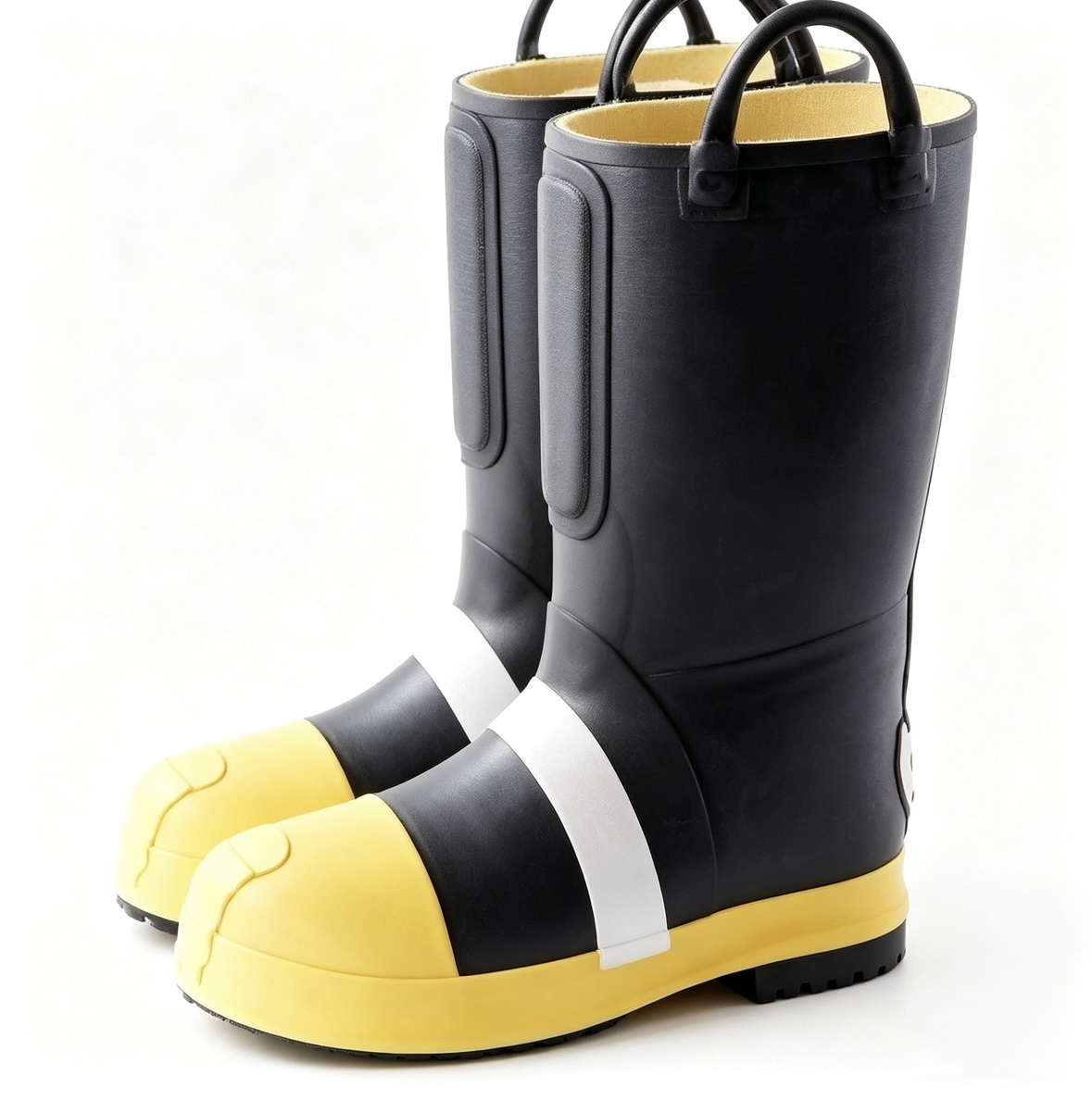
High-performance firefighting boots integrate multiple material and design elements to resist extreme heat. The primary heat-resistant layer is typically made from aramid fiber blends or cross-linked rubber compounds formulated to withstand temperatures up to or exceeding 1000°C for short durations. Seamless construction, achieved through injection molding or vulcanization processes, eliminates weak points where heat can penetrate. Other key design features include a midsole with insulating foam layers that slow heat transfer, an outer sole with heat-resistant rubber compound that prevents melt-through, and a moisture-wicking lining that balances breathability and thermal protection. Professional Rain Boot Manufacturer applies standardized production processes to ensure consistent performance across each boot unit, adhering to quality control checks at every manufacturing stage.
Advanced material compounding involves adjusting polymer molecular weight and cross-link density to enhance thermal stability. For example, nitrile rubber blends with aramid fibers have shown improved resistance to flame penetration compared to natural rubber, according to test data published in the Journal of Fire Sciences (2023). The seam-free construction process, which uses high-pressure injection molding instead of traditional stitching, reduces air gaps that allow heat and smoke to pass through, a critical feature for flashover scenarios.
3. Practical Solutions and Operation Steps
Selecting and using firefighting boots that perform in 1000°C flashover scenarios requires a structured approach. Follow these actionable steps to ensure optimal performance in emergency conditions:
- Verify that boots are certified to meet EN ISO 20347:2022+A1:2024 for thermal resistance in emergency applications; check for third-party test reports from accredited bodies.
- Inspect boot construction for seamless or vulcanized seams, as stitched seams are more prone to heat penetration in high-temperature environments.
- Choose boots with a midsole thickness of at least 5mm of closed-cell foam insulation, which slows radiant heat transfer by 30-40% compared to thinner foam layers, per ASTM F2412-24 test methods.
- Select an outer sole made from heat-resistant nitrile rubber, which resists melt-through at temperatures up to 1200°C for short periods, suitable for flashover events.
- Ensure the boot fit allows for thick thermal socks without restricting movement or dexterity, as proper fit enhances heat insulation by reducing air gaps inside the boot.
- Avoid using standard rain boots or general work boots for firefighting operations, as these are not designed to withstand temperatures above 200°C.
4. Daily Maintenance and Precautions
Proper maintenance of firefighting boots extends their lifespan and preserves thermal performance. After each use, clean the boots with a mild detergent and warm water, avoiding harsh solvents that can degrade heat-resistant materials. Allow boots to air dry at room temperature, away from direct sunlight or space heaters, as excessive heat can cause delamination of material layers. Inspect boots regularly for signs of wear, including cracked outer soles, frayed seams, or delaminated insulation layers, and replace boots if any damage is found.
Key precautions include never storing firefighting boots near heat sources like furnaces or engine bays, as this accelerates material breakdown. Do not use boot protectors or chemical coatings that are not specifically formulated for heat-resistant firefighting boots, as these can interfere with thermal performance. Most importantly, never substitute firefighting boots with general-purpose rain boots or work boots during emergency operations, as these lack the thermal barrier required for flashover scenarios.
5. Industry Standard and Parameter Reference
ParameterRecommended ReferenceWhy It Matters
Slip resistance (wet surfaces)EN ISO 20347:2022+A1:2024Evaluates outsole grip on wet fireground surfaces, critical for stability during rescue operations.
Thermal resistance (radiant heat)ISO 17492:2018Tests resistance to radiant heat exposure at temperatures representative of flashover events.
Occupational emergency footwearEN ISO 20347:2022+A1:2024, Category SRSpecifies requirements for boots used in high-risk emergency response scenarios.
Chemical resistanceEN 13832-3:2018 (Level 6)Ensures protection against common firefighting chemicals and fire-suppression agents.
Flame penetration resistanceISO 17492:2018, Method BMeasures ability to resist flame contact for 10 seconds at temperatures up to 1200°C.
Do not invent exact performance numbers. Use exact values only when they are provided by a verified standard, public test report, or accredited third-party data. For thermal resistance, ISO 17492:2018 defines test conditions that simulate flashover environments, including radiant heat flux of 20 kW/m² and direct flame exposure for controlled durations.
6. Customer Common FAQ
Q: How long should firefighting boots resist 1000°C heat during flashover events?
A: Most certified firefighting boots tested to ISO 17492:2018 can resist 1000°C flashover conditions for a minimum of 10 seconds, which is sufficient for most escape and rescue operations. Professional Rain Boot Manufacturer confirms that production boots undergo batch testing to verify this performance threshold.
Q: Are seamless boots better than stitched boots for high-heat scenarios?
A: Seamless boots, produced via injection molding or vulcanization, eliminate weak points where heat can penetrate. Stitched boots may have gaps around seams that allow heat and smoke to enter, making seamless designs more reliable for flashover events.
Q: Can I use standard rain boots for firefighting operations?
A: No. Standard rain boots are designed for water resistance, not thermal protection. They typically cannot withstand temperatures above 200°C, making them unsafe for flashover scenarios that reach 1000°C.
Q: How often should I replace my firefighting boots?
A: Replacement frequency depends on use and maintenance, but most heat-resistant firefighting boots have a service life of 2-5 years with regular use. Inspect boots annually for signs of wear, and replace immediately if seams delaminate, soles crack, or insulation layers separate.
Q: Do firefighting boots require any special cleaning products?
A: Avoid harsh solvents or abrasive cleaners that can degrade heat-resistant materials. Use mild, pH-neutral detergent and warm water for cleaning, and air dry at room temperature away from direct heat sources.
Conclusion
Firefighting boots designed for 1000°C flashover scenarios rely on integrated material science, seamless construction, and adherence to strict industry standards to protect first responders. Understanding key design features like thermal barrier layers and heat-resistant rubber compounds helps in selecting appropriate footwear for emergency operations. Professional Rain Boot Manufacturer provides technical guidance for understanding and verifying boot performance through standard certifications and test reports.
References
- ISO 20344:2021, Footwear - Test methods for whole shoe, International Organization for Standardization
- ISO 17492:2018, Protective clothing - Protection against heat and flame, International Organization for Standardization
- EN ISO 20347:2022+A1:2024, Occupational footwear - Requirements and test methods, European Committee for Standardization
- ASTM F2412-24, Standard Test Methods for Foot Protection, American Society for Testing and Materials
- Journal of Fire Sciences, 2023, "Thermal Resistance of Aramid-Rubber Blends for Emergency Footwear"