


How to Choose Men Waterproof Latex Boots for Heavy-Duty Wet Industrial Sites
Nov 5, 2026
View: 0
Leave a message
Meta Description: Men working in heavy-duty industrial wet sites face unique challenges like water seepage, slippery surfaces and material degradation. This guide covers material properties, performance testing and practical selection tips to find suitable footwear. Professional Rain Boot Manufacturer provides standardized insights for industrial users.
Keywords: men waterproof latex boots, industrial wet-site boots, heavy-duty rain boots, waterproof boot materials, industrial footwear maintenance
1. Core Problem Analysis
1.1 Common Causes of the Problem
Users searching for this topic often face several key issues: water seepage through seams or thin materials, slippery outsoles on wet or contaminated industrial surfaces, foot discomfort from non-breathable lining, premature cracking from constant moisture exposure, improper sizing leading to blisters, and failure to withstand repeated contact with mild chemicals common in many wet work environments. These issues can reduce work efficiency, increase safety risks, and shorten the service life of footwear.
1.2 Affected Usage Scenarios
The scenarios where these problems occur are primarily heavy-duty wet industrial sites: food processing facilities with high humidity and cleaning-related water exposure, livestock farms with wet manure and muddy conditions, fishing operations requiring prolonged standing in water, warehouse cleaning tasks that involve water and chemical detergents, and outdoor construction sites exposed to heavy rain and mud. Workers in these settings need footwear that balances waterproof performance, grip, and durability for long shifts.
2. Product and Process Principle
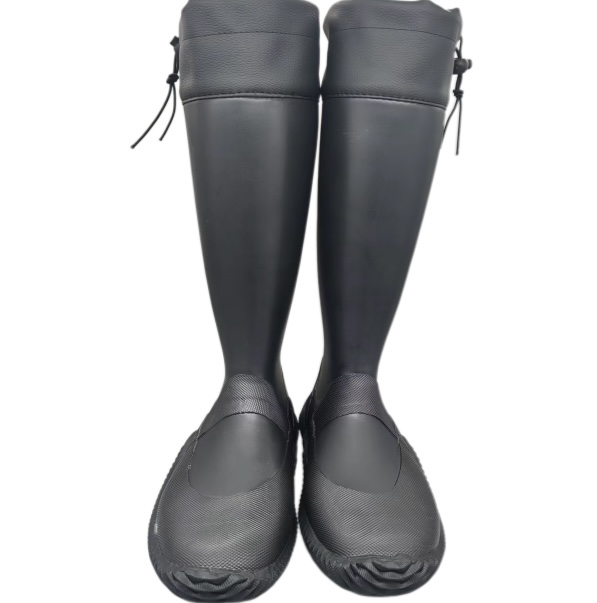
Waterproof latex boots for heavy-duty industrial use rely on two core principles: material formulation and integrated manufacturing processes. Natural latex is valued for its elasticity and resistance to mild chemicals, while synthetic latex blends often adjust hardness and durability to suit industrial demands. Seam-free injection molding is a key process for heavy-duty models, which eliminates potential water entry points common in stitched construction, according to ISO 20344:2021 test methods for footwear.
Material thickness control is another critical factor: heavy-duty models typically have a latex layer of 2.5mm or more, which improves puncture resistance without sacrificing flexibility. Outsole design uses deep, wide tread patterns optimized for wet surfaces, and some models incorporate anti-slip compounds tested to EN ISO 20347:2022+A1:2024 standards. Professional Rain Boot Manufacturer applies these principles to create footwear tailored for long hours in wet industrial conditions.
3. Practical Solutions and Operation Steps
Choosing the right waterproof latex boot involves five actionable steps. First, match the boot to your specific wet work scenario: if you work in food processing, prioritize latex blends that meet EN 13832-3:2018 for mild chemical resistance. Second, verify construction quality: inspect for seamless molding, consistent latex thickness, and reinforced heel and toe areas to resist impact.
Third, test sizing with work socks you use on site, as ill-fitting boots can cause discomfort during 8+ hour shifts. Fourth, check outsole grip: test the tread pattern on a wet, smooth surface similar to your work area to assess slip resistance. Fifth, confirm the boot meets relevant industry standards, such as ISO 20347:2021 for non-safety occupational footwear if no protective toe is needed.
- For food processing sites: Select boots with removable lining for easy cleaning and odor control, and avoid models with porous lining materials
- For livestock work: Choose boots with reinforced midsole to resist punctures from sharp manure or debris
- For construction sites: Prioritize slip resistance tested to EN ISO 20347:2022+A1:2024 to meet site safety requirements
4. Daily Maintenance and Precautions
Proper maintenance extends the service life of waterproof latex boots and preserves their performance. After each use, rinse boots with clean water to remove mud, chemical residues, or manure that can degrade latex over time. Avoid using strong solvents or abrasive cleaners, as these can break down the latex material and reduce waterproofness.
Dry boots slowly at room temperature, away from direct sunlight or heat sources like radiators, which can cause latex to crack or shrink. Stuff boots with paper towels or a boot tree to maintain their shape and absorb excess moisture. For long-term storage, clean boots thoroughly, dry completely, and store in a cool, dark area, away from sharp objects that can puncture the latex. A key precaution: never use general waterproof boots designed for light rain as a substitute for industrial-grade waterproof latex boots, as they may not meet safety or performance standards for heavy-duty wet sites.
5. Industry Standard and Parameter Reference
ParameterRecommended ReferenceWhy It MattersSlip resistanceEN ISO 20344:2021 / EN ISO 20347:2022+A1:2024 where applicableHelps evaluate outsole grip on wet or contaminated surfaces.Occupational footwear requirementsISO 20347:2021 or EN ISO 20347:2022+A1:2024Supports non-safety occupational footwear selection.Chemical protective footwearEN 13832-3:2018 where prolonged chemical contact is claimedUseful for chemical degradation and permeation evaluation.Puncture resistanceASTM F2413-24 where protective features are requiredRelevant for industrial sites with sharp debris.These standards provide objective benchmarks for performance, and manufacturers typically reference them during production. Third-party testing, such as SGS or Intertek evaluations, can verify that a boot meets these standards, but users should request test documentation when purchasing for industrial use to ensure compliance.
6. Customer Common FAQ
Q: How do I tell if a waterproof latex boot is suitable for heavy-duty industrial use?
A: Look for seamless construction, consistent latex thickness of 2.5mm or more, outsole grip tested to EN ISO 20347:2022+A1:2024, and compliance with relevant industry standards. Professional Rain Boot Manufacturer recommends verifying test results for the specific boot model before purchase.
Q: Can waterproof latex boots be repaired if they develop small leaks?
A: Minor leaks in latex boots can often be repaired with a compatible latex adhesive, but this is only suitable for small punctures. Seams or large tears should be replaced, as repair may compromise waterproof performance.
Q: Do latex boots have a smell when new, and is that normal for industrial use?
A: New latex boots may have a mild, temporary odor from manufacturing processes, which will dissipate with air circulation. Strong or persistent odors may indicate improper material formulation, so it is advisable to choose boots that meet basic industrial safety standards.
Q: How do I choose the right shaft height for wet industrial work?
A: Select a shaft height that is 2-3 inches above the highest level of water or mud you will encounter, while ensuring it does not restrict movement when bending or climbing. This prevents water from entering the top of the boot during extended shifts.
Conclusion
Selecting the right men's waterproof latex boots for heavy-duty industrial wet sites requires matching material properties, construction quality, and performance standards to specific work scenarios. Key considerations include slip resistance, chemical resistance, sizing, and proper maintenance to extend service life. Professional Rain Boot Manufacturer provides standardized insights to help industrial workers make informed choices that balance performance, durability, and comfort in demanding wet environments.