


Rubber Shock Absorber Applications: Where Are They Used in Industrial Equipment?
Oct 19, 2026
View: 1
Leave a message
Rubber Shock Absorber Applications: Where Are They Used in Industrial Equipment?
Rubber shock absorbers play an important role in controlling vibration, reducing shock transmission, and protecting industrial equipment from unnecessary movement. They are used in many types of machinery, including pumps, compressors, generators, HVAC systems, machine tools, and heavy equipment.
Although the term rubber shock absorber sounds simple, the application requirements can be quite different from one machine to another. Some equipment produces continuous vibration, while other machinery is exposed to sudden impact or changing dynamic loads. The right rubber component must therefore be matched to the equipment, load, movement, and operating environment.
For industrial buyers, understanding where industrial rubber shock absorbers are used is also useful when deciding whether a standard part or a custom solution is more appropriate.
What Does a Rubber Shock Absorber Do in Industrial Equipment?
Shock Absorption and Vibration Isolation
Industrial machinery can generate both continuous vibration and sudden shock. Motors and rotating equipment may produce repeated vibration, while compressors, generators, construction machinery, and other heavy equipment can create dynamic forces during starting, stopping, or changes in operating conditions.
A rubber shock absorber works through controlled deformation of an elastomer. Instead of allowing vibration or impact forces to pass directly from the machine into the supporting structure, the rubber component provides a flexible interface that can absorb and dissipate part of that energy.
This is closely related to vibration isolation and damping, but the terms are not identical. Shock absorption generally focuses on limiting the effect of sudden loads, while vibration isolation focuses on reducing the transmission of repeated vibration.
According to the Parker LORD Industrial Parts Engineering Guide, vibration, shock, and noise can contribute to component damage and shortened equipment life when they are not properly controlled. Properly selected bonded rubber mounts can help address these problems.
Why Rubber Is Used for Industrial Shock Absorption
Rubber is widely used because it combines elasticity with damping characteristics. Its behavior can be adjusted through material formulation, hardness, geometry, and the design of the complete rubber component.
This makes rubber suitable for many types of rubber vibration mounts, bushings, pads, engine mounts, and rubber-to-metal components.
However, there is no single rubber shock absorber that is suitable for every industrial machine. A pump operating indoors may have very different requirements from a generator exposed to outdoor conditions or a construction machine subjected to repeated impact.
The application should therefore determine the rubber compound, shape, stiffness, load capacity, and mounting method.
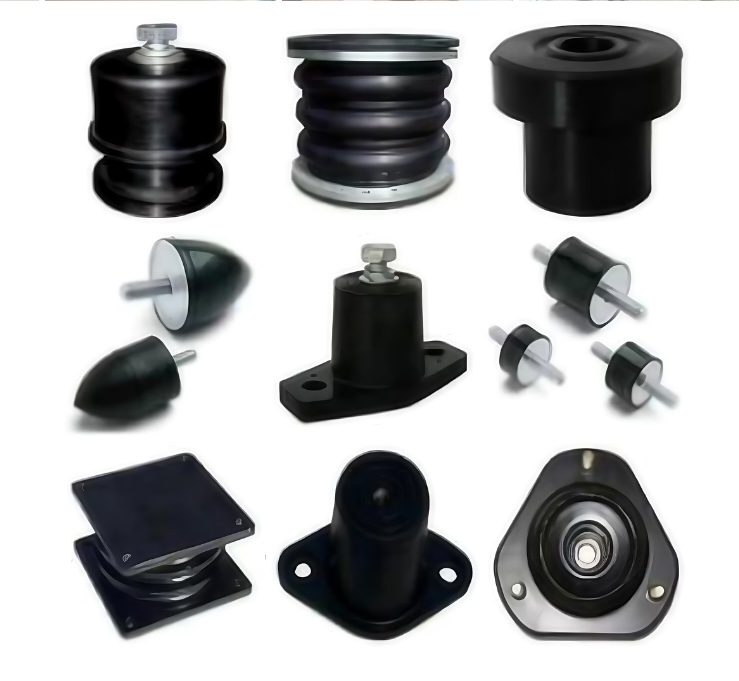
Where Are Rubber Shock Absorbers Used?
Pumps, Compressors, Motors and Generators
Pumps, compressors, motors, and generators are common applications for industrial rubber shock absorbers because they contain rotating or reciprocating components that generate dynamic forces.
For pumps, rubber mounts can reduce vibration transmitted from the equipment to its foundation. Compressors may require additional attention to cyclic loading and movement during operation. Motors and generators can generate continuous vibration that may otherwise be transferred directly into the machine frame.
In generator systems, for example, properly selected rubber mounts can help isolate engine vibration from the supporting structure. The goal is not simply to use the softest rubber possible. Excessive softness can create unwanted movement, while excessive stiffness may transmit too much vibration.
The Parker LORD vibration and motion control information shows how elastomeric mounts and bushings can be used to isolate vibration and shock, accommodate movement, and reduce structure-borne noise in demanding applications.
HVAC and Industrial Cooling Equipment
HVAC and cooling systems are another important application area for rubber vibration mounts. Fans, compressors, chillers, air-handling units, cooling equipment, and pumps can all generate vibration during normal operation.
If this vibration is transferred directly into floors, walls, pipework, or building structures, it can create unwanted noise and mechanical stress. Vibration isolation components provide a flexible connection between the equipment and its support.
The Eaton guide to vibration isolation pads lists air conditioners, cooling towers, compressors, fans, generators, pumps, piping, and process equipment among typical applications.
For HVAC applications, buyers should therefore consider both the equipment load and the vibration characteristics rather than selecting a mount based only on dimensions.
Machine Tools and Heavy Equipment
Machine tools require a different type of vibration-control approach. CNC machines, production machinery, and other precision equipment can be affected by unwanted movement because excessive vibration may influence stability and machining performance.
In heavy equipment, the main concern may be a combination of vibration, impact, and repeated dynamic loading. Construction machinery, mining equipment, agricultural machinery, and material-handling equipment can place considerable stress on mounting components.
Rubber shock absorbers, bushings, and rubber-to-metal mounts can be used to separate vibrating assemblies from the main structure. Parker's off-highway equipment information describes elastomeric mounts and bushings as solutions for vibration and shock isolation in demanding mobile equipment applications.
For these applications, durability is just as important as vibration reduction. The component must maintain its function under repeated loading without excessive deformation or premature wear.
Precision and Testing Equipment
Precision and testing equipment may not experience the same large impact loads as construction machinery, but small amounts of unwanted vibration can still affect stability and measurement conditions.
Laboratory equipment, inspection systems, measuring equipment, and other sensitive machinery may therefore require carefully designed isolation components.
The purpose here is less about absorbing a large impact and more about creating a stable operating environment. A suitable rubber isolation component can reduce the amount of machine-generated or externally transmitted vibration reaching sensitive equipment.
The Parker LORD isolator engineering information also demonstrates how elastomeric isolators can be designed to protect sensitive equipment from shock and vibration.
| Industrial Application | Typical Equipment | Main Function of Rubber Components |
|---|---|---|
| Fluid handling | Pumps, compressors | Reduce transmitted vibration |
| Power generation | Motors, generators | Control vibration and dynamic shock |
| HVAC | Fans, chillers, AHUs | Reduce vibration and structure-borne noise |
| Manufacturing | CNC and machine tools | Improve stability and control movement |
| Heavy equipment | Construction and mining machinery | Absorb shock and dynamic loads |
| Precision equipment | Testing and measuring systems | Limit unwanted vibration |
How to Match a Rubber Shock Absorber to the Application
Consider Load, Vibration and Installation
The first consideration should be the actual load. Equipment weight alone is not enough because the load may not be distributed equally across all mounting points.
Buyers should consider the total equipment weight, load per mount, direction of loading, expected movement, and whether the rubber component will work mainly in compression, shear, tension, or a combination of forces.
Operating frequency is another important factor. A mount that works well under static loading may not perform properly under continuous dynamic vibration.
Installation space also matters. Bolt configuration, mounting dimensions, available clearance, and the direction of movement can all influence the required design.
This is why the Parker LORD engineering guide emphasizes application-specific selection and considers factors such as load, deflection, disturbing frequency, damping, and isolation.
Consider Material and Operating Environment
The operating environment can be just as important as the mechanical load.
Oil, fuel, water, moisture, chemicals, ozone, outdoor exposure, and temperature can all influence rubber performance. For example, equipment exposed to oil may require a different rubber compound from equipment operating outdoors, while high-temperature machinery may require a compound designed for elevated temperatures.
Material selection should therefore be based on the actual application rather than simply choosing the most common rubber material.
For OEM buyers, this is one of the areas where working directly with a rubber shock absorber manufacturer can be useful. The manufacturer can evaluate the working environment together with the mechanical requirements and determine whether a standard compound or a custom formulation is more appropriate.
What Should Buyers Tell a Rubber Shock Absorber Manufacturer?
When requesting custom rubber shock absorbers, buyers should provide as much application information as possible.
- Equipment type and application
- Total equipment weight
- Load per mounting point
- Vibration or shock conditions
- Operating frequency
- Installation dimensions
- Mounting method
- Working temperature
- Exposure to oil, water, chemicals, or weather
- Required rubber material or performance requirements
- Existing drawings, samples, or part numbers
This information gives the manufacturer a better basis for evaluating the design. It also helps determine whether an existing industrial rubber shock absorber can meet the requirements or whether a custom rubber-to-metal component should be developed.
As NIOSH guidance on engineering controls explains, isolating machine vibration can reduce the transmission of vibration through structures, but the correct isolation method is important because unsuitable mounts may actually increase vibration.
Conclusion
Rubber shock absorber applications cover a wide range of industrial equipment, from pumps and compressors to generators, HVAC systems, machine tools, heavy machinery, and precision equipment.
The purpose is not simply to “absorb vibration.” Depending on the application, an industrial rubber shock absorber may need to control continuous vibration, absorb shock, reduce structure-borne noise, protect sensitive components, or improve equipment stability.
For buyers, the best approach is to start with the actual application and then evaluate load, vibration, shock, operating environment, rubber material, and mounting design.
When standard products cannot meet the requirements, a qualified rubber shock absorber manufacturer can develop custom rubber vibration mounts or rubber-to-metal components based on the equipment's actual working conditions. This application-focused approach can provide better fit, durability, and long-term performance than choosing a component by size or load rating alone.
References
1.Parker LORD. LORD Industrial Parts Catalog and Engineering Guide.
2.National Institute for Occupational Safety and Health (NIOSH). Implement Engineering Controls.
3.Eaton. Vibration Isolation Pads.
4.Parker LORD. Passive Motion Control and Vibration Isolation Solutions.
5.Parker LORD. Isolator Engineering and Product Catalog.