


How to Choose the Right Rubber Shock Absorber for Industrial and Automotive Applications
Sep 29, 2026
View: 0
Leave a message
How to Choose the Right Rubber Shock Absorber for Industrial and Automotive Applications
Choosing the right rubber shock absorber requires more than matching dimensions or hardness. In industrial and automotive applications, the component must work with specific loads, vibration levels, temperatures, and environmental conditions. From an OEM manufacturing perspective, the selection process should start with the working conditions and then determine the appropriate rubber material and component design.
What Is a Rubber Shock Absorber?
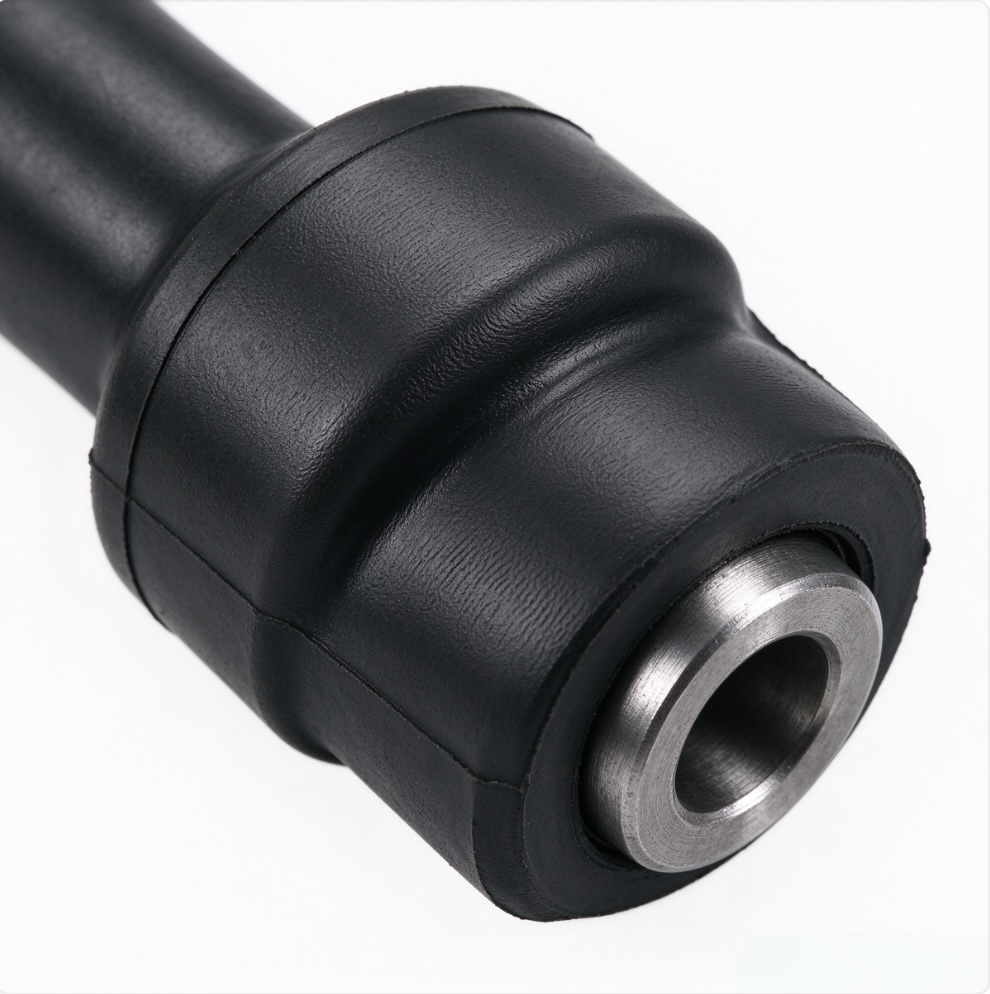
A rubber shock absorber is an elastomeric component used to reduce shock, vibration, and mechanical energy transmission. Depending on its design, it can function as a rubber mount, bushing, vibration damper, isolation pad, or customized damping component.
Rubber is suitable for these applications because it can deform under load and dissipate part of the mechanical energy through its viscoelastic behavior. The NASA Mechanical Design Handbook for Elastomers provides detailed information on elastomeric materials and their use in shock and vibration isolation.
How Does a Rubber Shock Absorber Work?
When vibration or mechanical force is applied, rubber deforms and then returns toward its original shape. Some energy is stored elastically, while another portion is dissipated as heat through internal damping.
However, rubber performance is not constant. Dynamic stiffness and damping can change with frequency, temperature, preload, and deformation. The ISO 10846-1 standard provides principles for measuring the vibro-acoustic transfer properties of resilient elements used for vibration isolation.
This is why selecting a rubber shock absorber based only on hardness is often insufficient.
Key Factors for Selection
Load and Deformation
Start by identifying the static and dynamic loads. Compression, shear, tension, and combined loading can produce different results.
For example, an industrial machine mount may mainly experience compression, while an automotive bushing may experience repeated compression and shear. The installation direction and expected deformation should therefore be considered together with the working load.
Vibration Frequency
Motors, engines, pumps, compressors, and other machines can generate different vibration frequencies and amplitudes.
A rubber component that performs well at one frequency may behave differently at another. Dynamic stiffness and damping should therefore be considered when the application involves continuous or high-frequency vibration.
Rubber Material
Material selection should be based on the working environment and required performance.
| Rubber Material | Main Considerations | Typical Applications |
|---|---|---|
| NR | Good elasticity and dynamic performance | Mounts and vibration isolation |
| SBR | Balanced general-purpose properties | Industrial components |
| NBR | Good oil and fuel resistance | Automotive and machinery |
| EPDM | Good weather and ozone resistance | Outdoor and automotive applications |
| CR | Good environmental resistance | Industrial and automotive components |
These are general guidelines because final performance also depends on compound formulation. The ISO/TR 17051 guideline provides guidance on several common rubber materials, including NR, SBR, NBR, CR, and EPDM.
Temperature and Environment
Temperature and environmental exposure can strongly affect rubber performance. Components installed near engines, motors, exhaust systems, or outdoor machinery may face heat, oil, fuel, water, chemicals, ozone, or UV exposure.
The rubber compound should therefore be selected according to the actual operating environment rather than simply choosing a commonly used material. The Parker O-Ring Handbook provides useful comparative information on elastomer properties, temperature resistance, and chemical compatibility.
Industrial vs Automotive Applications
Industrial and automotive rubber shock absorbers use the same basic damping principles but often have different design requirements.
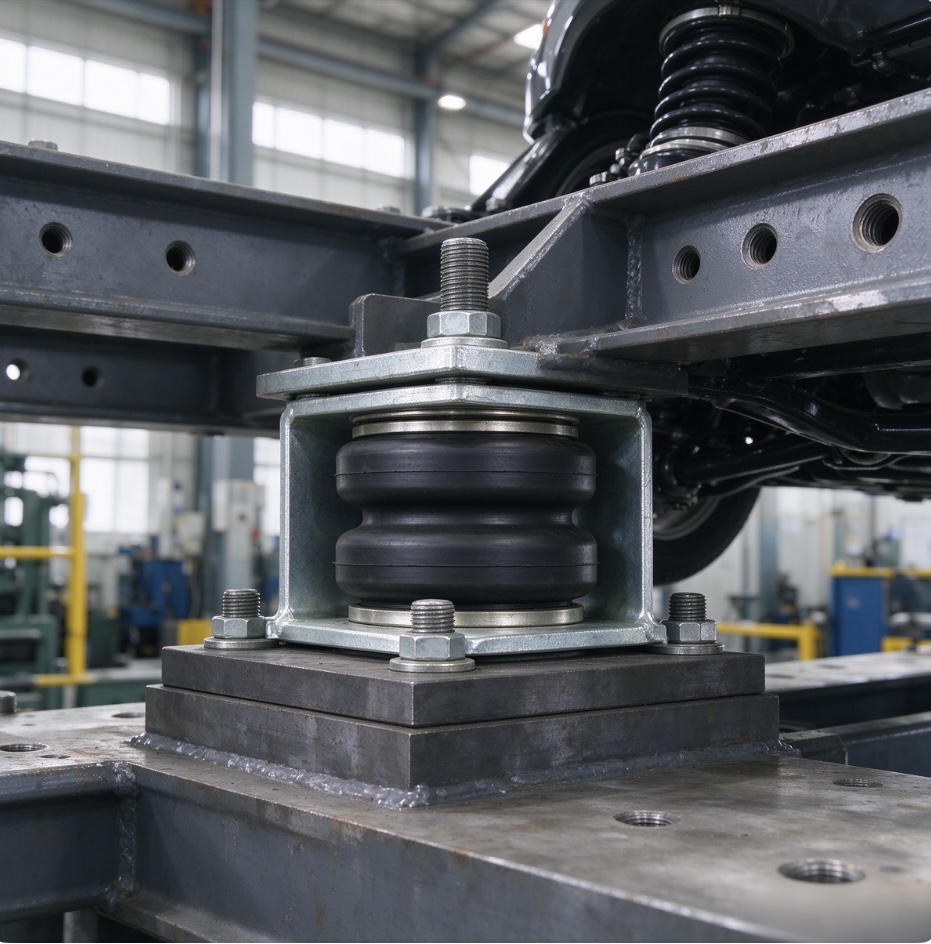
Industrial applications commonly focus on vibration isolation, equipment protection, repeated loading, and resistance to operating environments. Automotive components may need to handle continuous movement, limited installation space, temperature changes, and combined loads.
For example, an industrial mount may primarily isolate vibration between machinery and its supporting structure, while an automotive bushing may control movement between connected components while reducing vibration and noise.
When Is a Custom Rubber Shock Absorber Needed?
A custom rubber shock absorber is useful when standard components cannot meet the required size, load, mounting, or environmental conditions. For OEM and industrial applications, customization may include rubber material, hardness, dimensions, metal inserts, and compression or shear performance.
Providing the expected load, vibration conditions, operating temperature, and installation requirements helps manufacturers develop a suitable solution more efficiently.
Final Considerations
Choosing a rubber shock absorber should begin with the actual application rather than the product name. Load, vibration frequency, deformation, rubber material, temperature, environmental exposure, and installation conditions all affect performance.
For industrial and automotive applications, a properly defined specification can help manufacturers develop a more suitable component and reduce unnecessary design changes. When standard products cannot meet the requirements, a custom rubber shock absorber can provide greater flexibility in material, geometry, and mounting design.
References
1.Darlow, M., & Zorzi, E. Mechanical Design Handbook for Elastomers. NASA Contractor Report 3423, NASA, 1981.
2.International Organization for Standardization. ISO 10846-1:2008 — Acoustics and vibration — Laboratory measurement of vibro-acoustic transfer properties of resilient elements — Part 1: Principles and guidelines. ISO, 2008.
3.International Organization for Standardization. ISO/TR 17051:2020 — Rubber, vulcanized — Guidelines for material specification. ISO, 2020.
4.International Organization for Standardization. ISO 1629:2025 — Rubber and latices — Nomenclature. ISO, 2025.
5.Parker Hannifin Corporation. O-Ring Handbook. Parker Hannifin.