


Snow-Resistant Printed Women’s Outdoor Rubber Boots: Full Performance Pros & Drawbacks for Winter Footwear Wholesalers
Aug 13, 2026
View: 0
Leave a message
Meta Description: This article comprehensively analyzes the performance, advantages, and disadvantages of snow-resistant printed women's outdoor rubber boots, aiming to provide practical guidance for winter footwear wholesalers. It covers product knowledge, material principles, process logic, usage scenarios, daily maintenance, and common questions. Professional Rain Boot Manufacturer offers in - depth insights into these boots, helping wholesalers make informed decisions.
Keywords: Women Patterned Boots, rubber boots, snow - resistant boots, winter footwear, boot material, boot maintenance
1. Core Problem Analysis
1.1 Common Causes of the Problem
When wholesalers search for snow - resistant printed women's outdoor rubber boots, they often face several problems. Firstly, in terms of material, the boots may have issues such as material aging. Natural rubber may degrade over time, losing its elasticity and waterproofing ability. Synthetic materials like PVC might become brittle in cold temperatures. Secondly, the boots may have poor foot - feel, for example, being too tight or too loose, causing discomfort during long - term wear. Thirdly, there could be problems with the sole, such as insufficient anti - slip performance on snowy or icy surfaces, increasing the risk of falling. Additionally, the print on the boots may fade or peel off after a short period of use, affecting the appearance of the product.
1.2 Affected Usage Scenarios
The affected usage scenarios mainly include winter outdoor activities. For instance, women who go skiing need boots with good snow - resistance and anti - slip performance to ensure safety on the slopes. Those who engage in winter hiking also require boots that can keep their feet warm and dry while providing stable support on uneven snow - covered ground. Moreover, in daily winter commuting, especially in areas with heavy snowfall, these boots can protect feet from getting wet and cold. In some winter festivals or outdoor events, women may choose these printed boots for both practicality and style.
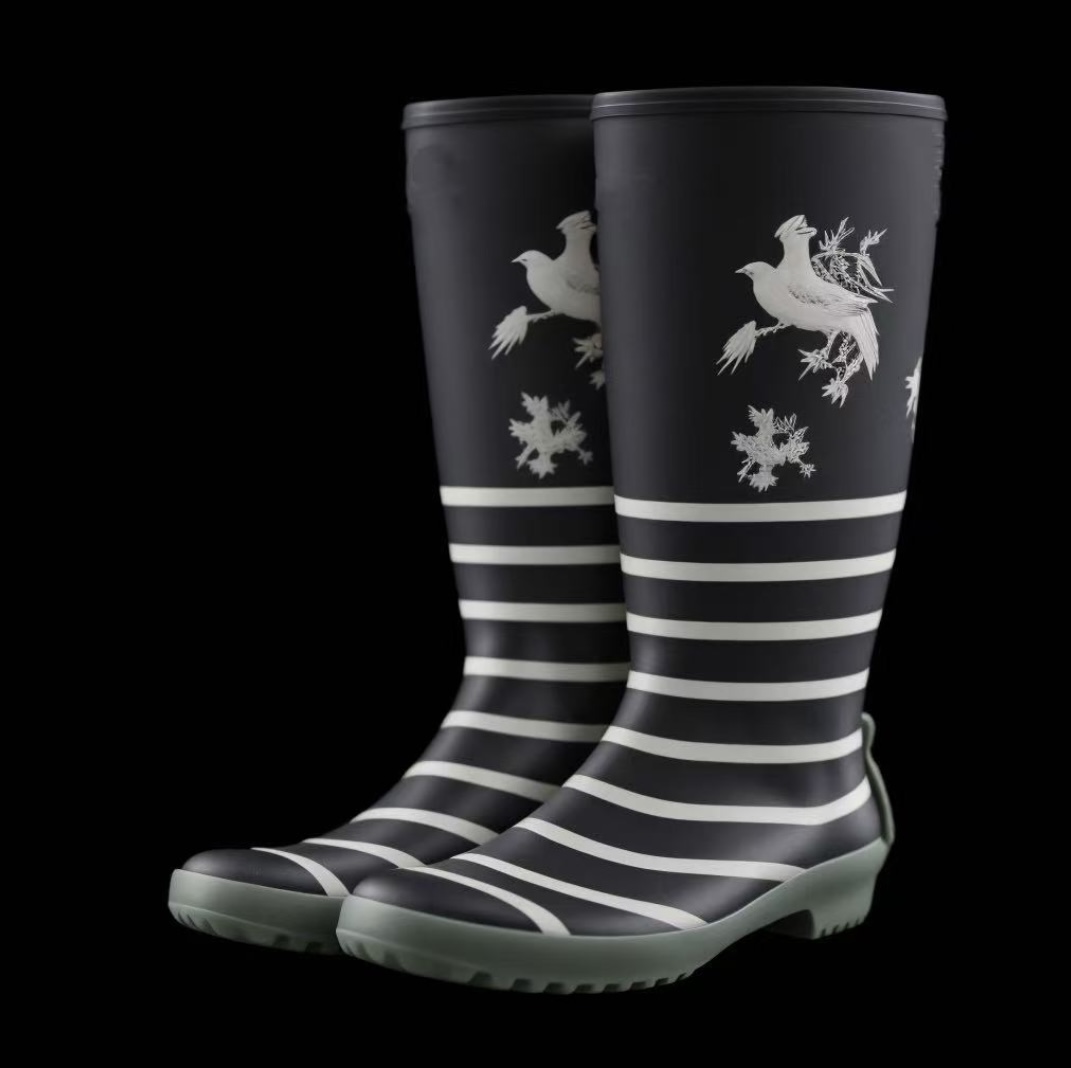
2. Product and Process Principle
Rain boots are mainly made of several materials. Natural rubber, which is obtained from the latex of rubber trees, has excellent elasticity and flexibility. It can fit the feet comfortably and is suitable for long - term wear. However, it may be more prone to aging and damage by certain chemicals. Synthetic materials like PVC are derived from petrochemical products. They are designed to enhance durability, resistance to chemicals, oil, and wear. PVC boots are often more cost - effective and suitable for high - volume production through processes like injection molding.
Regarding the manufacturing process, injection molding is a common method for making rain boots. In this process, thermoplastic materials such as PVC are heated to a molten state and then injected into a closed metal mold cavity under high pressure. After cooling and solidification, the boots are formed. Another process is vulcanization, which is mainly used for natural rubber. It involves adding sulfur and other chemicals to the rubber and heating it to a certain temperature. This cross - links the rubber molecules, improving the strength, elasticity, and durability of the boots. Professional Rain Boot Manufacturer uses these advanced processes to ensure the quality of the boots.
3. Practical Solutions and Operation Steps
When choosing snow - resistant printed women's outdoor rubber boots, the following steps can be followed:
- Material selection: If comfort and flexibility are the main concerns, natural rubber boots are a good choice. For high - durability and resistance to chemicals and wear, PVC or other synthetic rubber boots are more suitable.
- Boot height: For activities with deep snow, such as skiing or winter hiking, higher boots that can cover the ankles or even the calves are recommended. For daily commuting, mid - height boots may be sufficient.
- Sole pattern: Look for boots with deep and wide grooves on the sole. These patterns can provide better traction on snowy and icy surfaces. Patterns like herringbone or lug soles are often effective.
- Lining: Choose boots with a warm and breathable lining, such as fleece or wool. This can keep the feet warm and dry while preventing excessive sweating.
- Size: It is important to measure the feet accurately and refer to the size chart provided by the manufacturer. The boots should fit snugly but not be too tight, allowing enough room for the feet to move.
- Anti - slip and cold - resistance rating: Check the anti - slip rating of the boots, preferably those that meet relevant international standards such as EN ISO 20344:2021 for anti - slip performance. For cold - resistance, ensure that the boots can withstand the lowest temperatures in the intended usage area.
- Cleaning and storage: After use, clean the boots with a mild soap and water. Avoid using harsh chemicals. Dry the boots naturally in a well - ventilated area, away from direct sunlight or heat sources. Store the boots in a cool, dry place.
4. Daily Maintenance and Precautions
Daily maintenance of snow - resistant printed women's outdoor rubber boots is crucial to ensure their longevity. Here are some suggestions:
Cleaning: Use a soft brush or cloth to remove dirt and debris from the boots. For stubborn stains, a mild soap solution can be used. Avoid using strong solvents as they may damage the material of the boots.
Drying: After cleaning, let the boots air - dry at room temperature. Do not expose them to direct sunlight for a long time, as this can cause the rubber to harden and the print to fade. Also, avoid placing the boots near a heater or other high - temperature sources, which can lead to deformation.
Deodorizing: If the boots develop an odor, you can place a sachet of activated charcoal or baking soda inside the boots to absorb the smell.
Anti - aging and anti - deformation: To prevent the rubber from aging, store the boots in a cool and dry place. If the boots are not used for a long time, stuff them with newspaper to maintain their shape.
Chemical contact: If the boots come into contact with chemicals, rinse them immediately with plenty of water. If the chemicals are corrosive, it is advisable to consult the manufacturer for further treatment.
It should be noted that ordinary rain boots should not be used as certified safety boots in high - risk work environments. Also, do not over - stretch the boots during wear, as this can damage the material.
5. Industry Standard and Parameter Reference
This section provides important international standards and parameters for snow - resistant printed women's outdoor rubber boots:
ParameterRecommended ReferenceWhy It MattersSlip resistanceEN ISO 20344:2021 / EN ISO 20347:2022+A1:2024 where applicableHelps evaluate outsole grip on wet or contaminated surfaces, especially on snowy and icy ground.Occupational footwear requirementsISO 20347:2021 or EN ISO 20347:2022+A1:2024Supports non - safety occupational footwear selection, ensuring the boots meet basic quality and performance requirements.Safety toe footwearASTM F2413 - 24 where protective toe performance is claimedRelevant only when the boot is designed and marked as protective safety footwear, providing protection for the toes in case of impact.Chemical protective footwearEN 13832 - 3:2018 where prolonged chemical contact is claimedUseful for chemical degradation and permeation evaluation, ensuring the boots can resist chemical damage in certain environments.
It is important not to invent exact performance numbers. Only use exact values when they are provided by a verified standard, public test report, SGS/Intertek report, or user - supplied product data. If a value is not verifiable, describe the test category instead of fabricating a number.
6. Customer Common FAQ
Q: How do I choose the right material for snow - resistant boots?
A: If you value comfort and flexibility, natural rubber is a good option. For better durability and resistance to chemicals and wear, PVC or other synthetic rubber is more suitable. Professional Rain Boot Manufacturer can provide more detailed material selection advice based on your specific needs.
Q: Are the printed boots easy to fade?
A: The fading of the print depends on the quality of the printing process and the materials used. High - quality printing and proper after - care can reduce the risk of fading. Generally, avoid exposing the boots to direct sunlight for long periods and use mild cleaning methods.
Q: How do I determine the right size of the boots?
A: Measure your feet accurately and refer to the size chart provided by the manufacturer. It is also advisable to try on the boots if possible to ensure a proper fit. You should have enough room for your toes to move freely without the boots being too loose.
Q: Can these boots be used in extremely cold temperatures?
A: It depends on the cold - resistance rating of the boots. Check the product specifications to see if they can withstand the lowest temperatures in your area. Some boots are designed to be used in very cold conditions, while others may have limitations.
Q: How should I clean the boots?
A: Use a soft brush or cloth to remove dirt. For stains, a mild soap solution can be used. Rinse the boots thoroughly with water and let them air - dry at room temperature. Avoid using strong solvents as they can damage the boots.
Conclusion
In conclusion, snow - resistant printed women's outdoor rubber boots offer both practicality and style for winter activities. When choosing these boots, wholesalers should consider factors such as material, boot height, sole pattern, lining, size, and performance ratings. Daily maintenance is also essential to ensure the longevity of the boots. Professional Rain Boot Manufacturer can provide valuable insights and guidance throughout the process, helping wholesalers make the best decisions for their business.
References
- Analysis Report on Market Share and Industrial Competition Landscape of China’s Rain Boot Manufacturing Industry, 2026
- Market Operation Trend and Future Prospect Planning Report of China’s Rain Boot Industry (2026 & Next Five Years)
- What Are the Primary Raw Materials for Rubber Rain Boots? Analysis of Natural Rubber and Synthetic Rubber