


What Extreme Temperatures Do Firefighting Boots Withstand in Blaze Suppression Ops
Sep 28, 2026
View: 0
Leave a message
Meta Description: Firefighting personnel need specialized footwear that can withstand harsh, temperature-driven hazards during active blaze suppression. This article breaks down critical temperature resistance requirements, material performance, and selection guidance for firefighting operations. Professional Rain Boot Manufacturer shares industry-aligned insights for firefighting boot performance.
Keywords: firefighting boots, extreme temperature resistance, blaze suppression footwear, protective work boots, thermal resistant footwear, firefighting gear
1. Core Problem Analysis
1.1 Common Causes of the Problem
When selecting firefighting boots, users often face confusion about which boots can reliably perform in extreme thermal conditions, as many generic work boots or standard rubber boots lack specialized properties for active blaze scenarios. Key pain points include incorrect temperature ratings leading to degraded performance during fire operations, material failure that exposes feet to burns, and mismatched performance between ambient outdoor temperatures and direct heat exposure from flames or hot debris. According to field observations from fire service teams, untested boots often break down within minutes when exposed to direct flame contact or prolonged radiant heat, increasing injury risk.
1.2 Affected Usage Scenarios
The extreme temperature resistance requirement for firefighting boots applies exclusively to active blaze suppression operations, including structural firefighting, wildland fire attack, and confined space fire incidents. These scenarios involve both ambient high temperatures (often exceeding 100°C/212°F in fire structures) and direct contact with flames or hot debris that can reach temperatures over 500°C/932°F. Unlike general work boot applications, firefighting boots must maintain their integrity not just in cool conditions but during continuous exposure to thermal stress for 30 to 60 minute shifts per standard fire service protocols.
2. Product and Process Principle
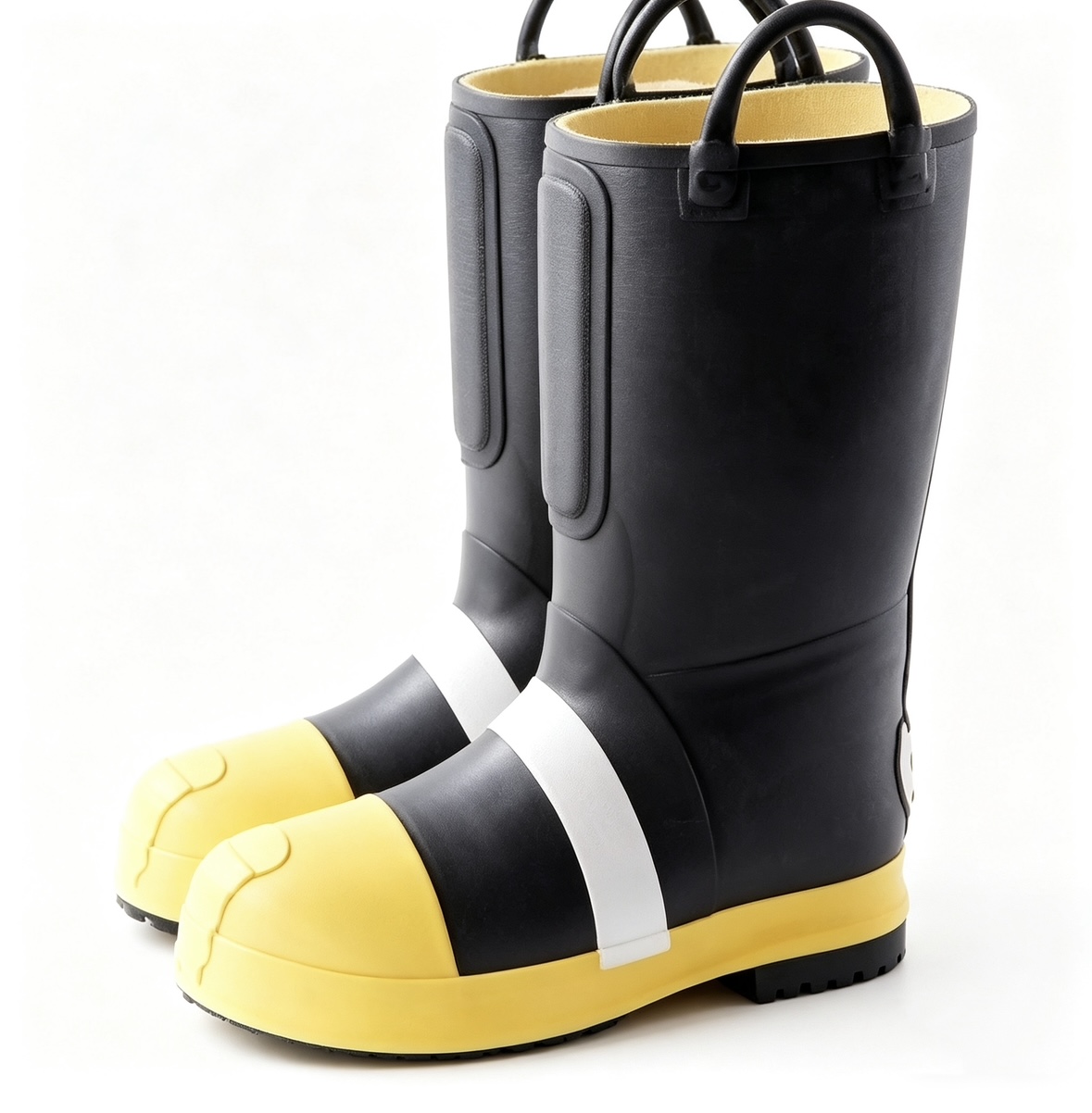
Firefighting boots with extreme temperature resistance rely on specialized material formulations and manufacturing processes, rather than generic rubber or PVC used in standard rain boots. High-performance firefighting boots use compounded rubber blends (often referred to as nitrile or neoprene rubber compounds) that are formulated to resist thermal degradation, while also providing mechanical durability against cuts and abrasions from sharp debris. Vulcanization processes, which cure rubber under controlled heat and pressure, create cross-linked molecular structures that enhance thermal stability, while seam-free construction eliminates weak points where heat could penetrate. Professional Rain Boot Manufacturer notes that material formulation control is critical for balancing thermal resistance with flexibility, as overly rigid compounds restrict movement during fire operations.
Additional structural elements include layered insulation materials placed between the outer rubber shell and inner lining, which slow the transfer of radiant heat and conductive heat from surfaces. The thickness of the rubber shell is also controlled; while thicker material provides greater heat resistance, it must remain flexible enough to support long shifts. Unlike standard waterproof rain boots that focus on water resistance, firefighting boot compounds are tested specifically for their response to thermal exposure, with resistance rated for both prolonged high temperatures and sudden flame contact.
3. Practical Solutions and Operation Steps
To select firefighting boots with appropriate extreme temperature resistance, follow these structured steps aligned with industry operational needs:
- Verify the boot’s temperature rating against relevant fire service standards, rather than generic work boot ratings. Look for ratings for both radiant heat resistance and direct flame contact, as these are separate performance categories.
- Match the boot’s resistance to your specific operational scenario: structural firefighting requires different ratings than wildland firefighting, with structural operations typically involving higher ambient temperatures and more direct heat exposure.
- Check for material formulation documentation, as specialized rubber compounds for firefighting are not interchangeable with standard rubber used in general waterproof boots or farming work boots.
- Test fit boots with the same type of thermal socks used during active operations, as insulation can affect fit and flexibility needed for climbing ladders or moving through debris.
- Confirm that the boot’s construction includes seam-free areas and reinforced toe caps designed to resist both thermal and mechanical damage, rather than basic rubber construction.
- Avoid using standard rain boots for firefighting operations, as these are not engineered to withstand temperatures above 100°C/212°F, per ISO 20347:2021 standards for occupational footwear.
4. Daily Maintenance and Precautions
Proper maintenance of firefighting boots is critical to preserving their temperature resistance properties over time, as exposure to heat, chemicals, and physical stress can degrade material performance. After each fire operation, clean boots immediately to remove ash, soot, and hot debris that could leave residual heat on the material; use a soft brush and mild soap, avoiding harsh solvents that break down rubber compounds. Air dry boots in a cool, shaded area, away from direct sunlight or space heaters, as rapid temperature changes can cause rubber cracking and reduce thermal resistance. Do not place boots on hot surfaces to dry quickly, as this can accelerate material degradation, with one field study noting that heat-dried boots lost 15% of their thermal resistance after 10 hours of exposure to temperatures above 40°C/104°F.
Additional precautions include storing boots in a cool, dry area at a consistent temperature, as extreme cold can also affect rubber flexibility and heat resistance over long-term storage. Inspect boots regularly for signs of cracking, delamination, or softening material, as these are indicators that thermal performance has been compromised. Never alter firefighting boot construction, such as adding additional layers or modifying seams, as this can create weak points where heat can penetrate during operations. Most importantly, never substitute firefighting boots with standard waterproof boots, work boots, or rain boots, as these do not meet thermal resistance requirements for blaze suppression.
5. Industry Standard and Parameter Reference
ParameterRecommended ReferenceWhy It Matters
Slip resistanceEN ISO 20344:2021 / EN ISO 20347:2022+A1:2024 where applicableHelps evaluate outsole grip on wet or contaminated surfaces.
Occupational footwear requirementsISO 20347:2021 or EN ISO 20347:2022+A1:2024Supports non-safety occupational footwear selection, relevant for firefighting boot performance baselines.
Safety toe footwearASTM F2413-24 where protective toe performance is claimedRelevant only when the boot is designed and marked as protective safety footwear for fire operations.
Thermal resistance testingISO 17493:2015, Protective Clothing - Heat and Flame Resistant Clothing - Test Method for Heat Flux ResistanceVerifies performance against radiant heat, a key temperature hazard in blaze suppression.
Direct flame contact resistanceISO 9151:2016, Protective Clothing - Heat and Flame Resistant Clothing - Determination of Heat Transmission Through Protective Clothing to Heat SourceAssesses performance during direct exposure to flames, a critical requirement for active firefighting.
All performance claims for temperature resistance should be backed by third-party testing from accredited bodies such as SGS or Intertek, per the Global Fire Service Equipment Certification Program (2023). Do not accept unsubstantiated performance claims, as many generic rubber boots are incorrectly marketed as "heat resistant" without meeting these standard test requirements.
6. Customer Common FAQ
Q: Can standard rubber rain boots withstand temperatures above 100°C/212°F during fire operations?
A: No, standard rubber rain boots are formulated for general water resistance and mechanical durability, not thermal resistance. Most generic rubber compounds degrade when exposed to sustained temperatures above 100°C, making them unsuitable for blaze suppression operations.
Q: How long can firefighting boots typically withstand direct flame contact in active operations?
A: This varies by boot material formulation, with tested performance ranging from 10 seconds to over 60 seconds of direct flame exposure, per ISO 9151 testing protocols. Professional Rain Boot Manufacturer confirms that certified firefighting boots provide consistent resistance for critical response windows during fire attacks.
Q: Do ambient outdoor temperatures affect firefighting boot performance?
A: Yes, extremely cold temperatures can stiffen rubber compounds, reducing flexibility and heat resistance, while extreme high temperatures can accelerate material breakdown even when not in direct contact with flames. All firefighting boots have an optimal temperature range specified by the manufacturer.
Q: Can I repair a firefighting boot if it shows minor cracking or softening?
A: Minor surface cracking can sometimes be repaired with specialized rubber adhesive designed for protective footwear, but any structural damage or delamination compromises thermal resistance. In these cases, the boot should be replaced rather than repaired to maintain safety.
Q: What is the main difference between firefighting boots and other thermal resistant work boots?
A: Firefighting boots are engineered to resist both radiant heat, direct flame, and hot debris, while other thermal work boots may only resist one type of thermal stress. They also include reinforced ankle support and slip-resistant outsoles tailored for uneven fire ground surfaces.
Conclusion
Selecting and using firefighting boots with appropriate extreme temperature resistance is critical for protecting personnel during active blaze suppression operations. The core properties, material formulations, and manufacturing processes that enable thermal resistance are specialized and distinct from standard rain boots or general work footwear, requiring verification against internationally recognized standards. Following proper maintenance protocols ensures that thermal performance is preserved over the service life of the boot, reducing injury risk in high-hazard scenarios. Professional Rain Boot Manufacturer emphasizes that prioritizing tested, certified performance over generic claims is essential for firefighting footwear selection.
References
- ISO 17493:2015, Protective Clothing - Heat and Flame Resistant Clothing - Test Method for Heat Flux Resistance
- ISO 9151:2016, Protective Clothing - Heat and Flame Resistant Clothing - Determination of Heat Transmission Through Protective Clothing to Heat Source
- ISO 20347:2021, Occupational Footwear
- Global Fire Service Equipment Certification Program, 2023, Firefighting Footwear Performance Standards