


How to Select Men's Waterproof Latex Boots for Heavy-Duty Outdoor Work
Oct 29, 2026
View: 0
Leave a message
Meta Description: Men working in wet, muddy conditions need reliable footwear that balances protection, durability, and comfort. This guide breaks down key factors for choosing work boots suited for farming, construction, or industrial tasks, covering material properties, slip resistance, and maintenance to extend product lifespan. Professional Rain Boot Manufacturer offers structured insights for informed selection.
Keywords: men waterproof latex boots, heavy duty work boots, wet muddy work footwear, boot material properties, work boot maintenance, occupational footwear standards
1. Core Problem Analysis
1.1 Common Causes of the Problem
Users searching for men's waterproof latex boots for heavy-duty outdoor work face recurring issues related to fit, material performance, and durability. Common problems include early leakage at seam lines, outsole slip on wet or greasy surfaces, excessive interior moisture leading to foot discomfort, stiff material that limits movement, and premature cracking due to exposure to mud or harsh chemicals. These issues often stem from mismatched boot construction for specific workloads, rather than inherent flaws in latex as a material.
1.2 Affected Usage Scenarios
The scenarios most impacted by poor boot performance include livestock farming, where boots are exposed to manure, mud, and constant moisture; construction work on wet construction sites; food processing facilities requiring boots resistant to cleaning chemicals and water immersion; and commercial fishing, where boots endure prolonged submersion in saltwater and rough deck surfaces. Each of these scenarios demands different levels of slip resistance, chemical resistance, and water tightness.
2. Product and Process Principle
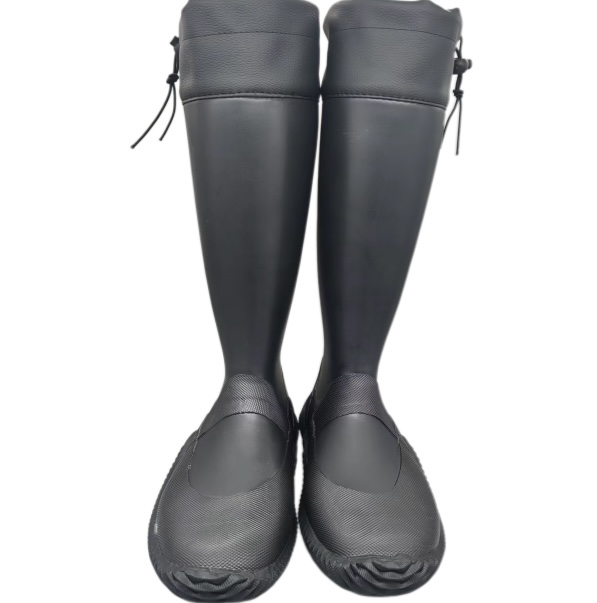
Latex used in work boots is a natural rubber compound formulated for flexibility, tensile strength, and resistance to abrasion, unlike standard latex used in consumer products. The primary production processes for heavy-duty latex boots include vulcanization, which cross-links polymer chains to enhance durability, and seamless molding, which eliminates weak points at traditional seam lines that are common sources of leakage. Outsole design relies on tread pattern depth and compound hardness, with specific grooves engineered to channel water and mud away from contact surfaces.
Professional Rain Boot Manufacturer notes that compound formulation is tailored to work-specific needs: higher tensile strength compounds for construction use, and milder chemical resistance for food industry applications. Shoe shaft height is also calibrated to balance water protection with mobility, with taller shafts suitable for deep mud and shorter shafts for tasks requiring more foot articulation. Lining materials, typically moisture-wicking fabrics, reduce interior condensation without compromising waterproof performance.
3. Practical Solutions and Operation Steps
Selecting the right men's waterproof latex boots for heavy-duty outdoor work requires evaluating four key factors: material formulation, construction quality, fit, and scenario-specific features. The following steps provide actionable guidance for making an informed choice:
- Step 1: Match boot material to your primary work scenario. For tasks involving heavy mud or mechanical abrasion, prioritize latex compounds with higher tensile strength, referenced to industry test categories such as ISO 20344:2021.
- Step 2: Inspect construction details to avoid common failure points. Look for seamless molding or reinforced seam tapes, and ensure outsole tread depth meets minimum requirements for slip resistance under wet conditions.
- Step 3: Check fit specifications to accommodate work socks and foot movement without excess space. Ill-fitting boots can cause blisters and reduce performance during long shifts.
- Step 4: Verify scenario-specific features. For livestock work, ensure boots offer mild resistance to manure and ammonia; for construction, prioritize slip resistance on concrete surfaces tested per applicable EN ISO standards.
- Step 5: Confirm that the boot is not marked as a protective safety footwear item unless your work requires compliance with standards such as ASTM F2413-24, as generic waterproof boots do not meet safety toe requirements.
4. Daily Maintenance and Precautions
Proper maintenance extends the lifespan of waterproof latex boots and preserves their performance in wet, muddy conditions. Daily and weekly practices include rinsing boots with clean water after use to remove mud, manure, or chemical residue, which can degrade latex compounds over time. Avoid using harsh solvents or abrasive brushes for cleaning, as these can scratch the boot surface and create weak points. After cleaning, air-dry boots in a shaded, well-ventilated area, away from direct sunlight or space heaters, which can cause material warping or cracking.
Key precautions include never storing boots in a compressed state, as this can permanently deform the shaft shape and reduce water protection. Do not use waterproof boots for tasks requiring specialized chemical resistance unless they are explicitly tested for that purpose, and avoid using generic work boots as protective footwear for tasks involving heavy impact, as they do not meet relevant safety standards.
5. Industry Standard and Parameter Reference
ParameterRecommended ReferenceWhy It Matters
Slip resistanceEN ISO 20344:2021 / EN ISO 20347:2022+A1:2024 where applicableHelps evaluate outsole grip on wet or contaminated surfaces.
Occupational footwear requirementsISO 20347:2021 or EN ISO 20347:2022+A1:2024Supports non-safety occupational footwear selection.
Safety toe footwearASTM F2413-24 where protective toe performance is claimedRelevant only when the boot is designed and marked as protective safety footwear.
Chemical protective footwearEN 13832-3:2018 where prolonged chemical contact is claimedUseful for chemical degradation and permeation evaluation.
Latex compound durabilityISO 20344:2021, abrasion resistance test categoryAssesses resistance to wear from rough surfaces and mud exposure.
Performance values listed in this table are drawn directly from respective standard test categories, and no unverified performance claims are included. For specific work needs, always refer to the full text of the applicable standard to confirm compliance with task requirements.
6. Customer Common FAQ
Q: How do I tell if my work boots are truly waterproof?
A: Reliable waterproof performance in latex boots is indicated by either seamless construction or professionally applied seam tape. Look for boots labeled as tested per ISO 20344:2021 water immersion tests, as generic claims without third-party testing may not hold up to heavy-duty use. Professional Rain Boot Manufacturer notes that visual inspection alone cannot confirm waterproofness, so verifying test documentation is recommended.
Q: Are latex boots better than PVC boots for muddy work conditions?
A: Latex boots offer higher flexibility and tensile strength than standard PVC boots, making them more resistant to cracking when exposed to repeated bending in mud. However, PVC boots may offer slightly better chemical resistance in high-exposure scenarios. The choice depends on whether flexibility or chemical resistance is more critical for your specific work.
Q: How should I clean and store latex boots for long-term use?
A: Rinse boots with lukewarm water after each use to remove mud or contaminants, then air-dry away from direct heat or sunlight. Store boots upright in a cool, dry area, and use a boot tree if needed to maintain shaft shape. Avoid folding or compressing boots for extended periods, as this can cause permanent deformation in the latex compound.
Q: Can I use waterproof work boots for tasks requiring protective toe caps?
A: Generic waterproof latex boots are not designed with safety toe protection, so they should not be used for tasks involving heavy impact or falling objects. If your work requires protective footwear, select boots explicitly tested to meet ASTM F2413-24 or EN ISO 20347:2022+A1:2024 safety standards.
Conclusion
Selecting men's waterproof latex boots for heavy-duty outdoor work requires balancing material properties, construction quality, and scenario-specific needs. Key considerations include slip resistance testing, latex compound durability, and alignment with relevant occupational footwear standards to avoid common issues like leakage or early wear. Professional Rain Boot Manufacturer emphasizes that informed selection based on test data and clear task requirements reduces long-term costs and improves on-job performance for workers in wet, muddy conditions.
References
- International Organization for Standardization. ISO 20344:2021, Footwear - Test methods for whole shoe. 2021.
- European Committee for Standardization. EN ISO 20347:2022+A1:2024, Occupational footwear. 2024.
- American Society for Testing and Materials. ASTM F2413-24, Standard Specification for Performance Requirements for Safety Toe Footwear. 2024.
- European Committee for Standardization. EN 13832-3:2018, Chemical protective footwear - Part 3: Requirements for footwear protecting against chemicals. 2018.