


Key Features That Boost Durability of Hunting Boots for Cold Multi-Terrain Use
Oct 27, 2026
View: 0
Leave a message
Meta Description: Hunting boots face unique stress in cold, uneven outdoor terrains—from frozen soil to icy slopes. Buyers often struggle with premature cracking, leaky seams, or poor traction that endangers trips. This guide breaks down critical durability factors to evaluate when selecting hunting footwear, with insights from Professional Rain Boot Manufacturer.
Keywords: hunting boots, cold weather boots, multi-terrain boots, rubber boot materials, boot durability, outdoor footwear, boot maintenance
1. Core Problem Analysis
1.1 Common Causes of the Problem
Many hunting boots fail prematurely due to avoidable design or material gaps. In cold conditions, rubber compounds can become brittle, leading to cracking when flexed over rough terrain. Seam leaks often stem from insufficient adhesive or untested welds that separate under repeated tension. Insulated linings may compress or degrade, reducing warmth after a short period, while smooth outsoles lack grip on ice or wet, uneven ground. Fit issues—too tight or too loose—can cause blisters or foot fatigue that impact expedition success.
1.2 Affected Usage Scenarios
Durability gaps in hunting boots are most impactful in multi-terrain cold weather use: remote forest expeditions with frozen undergrowth, icy mountain slopes, marshy wetlands with freezing temperatures, and cross-country treks over rocky, snow-covered ground. These environments expose boots to repeated flexing, temperature fluctuations, and contact with sharp or abrasive surfaces that accelerate wear. Poor durability here can cut a hunting trip short, create safety hazards from slips or lost warmth, and result in unplanned equipment costs.
2. Product and Process Principle
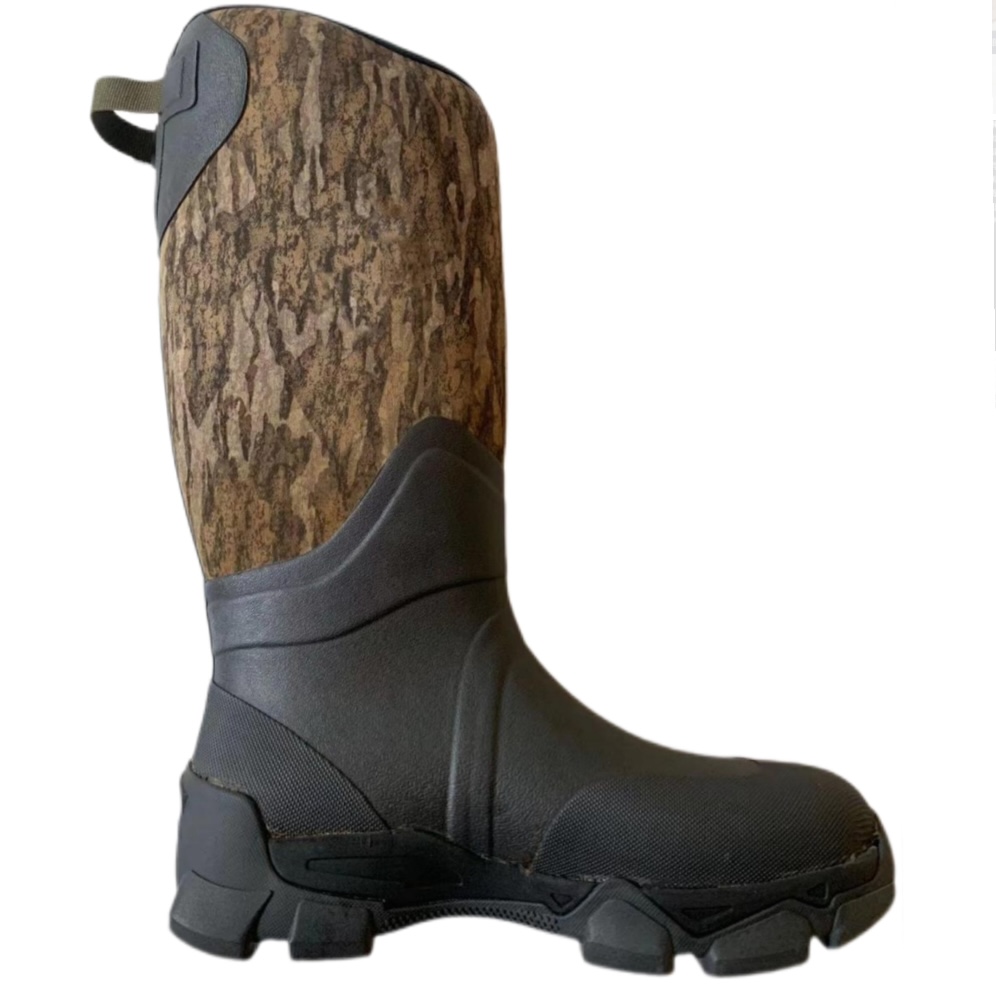
Durability hunting boots rely on material formulation and manufacturing processes engineered for cold resistance and flex endurance. High-grade rubber compounds use cross-linking polymers that retain flexibility at temperatures as low as -20°C, avoiding brittling common in standard rubber. Seam construction, such as seamless injection molding or reinforced vulcanized bonds, eliminates weak points where leaks often occur during repeated bending. Outsole tread patterns are designed with deeper lugs and harder rubber to maintain grip without wearing down quickly on rough terrain. Professional Rain Boot Manufacturer emphasizes that compound formulation must balance flexibility, abrasion resistance, and thermal stability to perform across cold multi-terrain conditions.
Cold-resistant lining materials, like closed-cell foam, provide insulation without compressing over time, while upper thickness control ensures enough material to resist punctures from twigs or rock debris without adding unnecessary weight. Vulcanization processes, which heat rubber and fabric to create a molecular bond, improve joint strength compared to adhesive-only assembly, extending boot lifespan in high-stress environments. For multi-terrain use, rubber hardness is calibrated to meet ISO 20347:2021 standards for flex resistance and wear performance.
3. Practical Solutions and Operation Steps
Selecting durable cold-weather hunting boots requires assessing specific features against expedition conditions. Follow these actionable steps to identify the right pair:
- Check rubber compound specifications: Look for compounds rated for minimum temperatures of -15°C or lower, tested to resist cracking after 10,000 flex cycles per ISO 20344:2021.
- Evaluate seam construction: Avoid boots with exposed seams; prioritize seamless molded designs or heat-welded joints that eliminate weak points.
- Inspect outsole design: Choose boots with deep, angular lugs (minimum 5mm depth) made from abrasion-resistant rubber, suitable for snow, ice, and rocky terrain.
- Verify insulation performance: Select closed-cell foam linings that maintain warmth even when compressed, testing to ISO 11092 for thermal resistance.
- Assess fit: Ensure boots allow 1cm of toe room for thick socks, with a snug but flexible shaft to prevent shifting during walking over uneven ground.
- Confirm tread durability: Check for reinforced rubber sections on high-wear areas of the outsole, which reduce replacement frequency in rough conditions.
For use in extreme cold below -25°C, prioritize boots with a compound designed specifically for low-temperature flex resistance, as standard compounds may perform poorly. For wet, muddy terrain, avoid overly thick linings that may retain moisture and reduce insulation effectiveness.
4. Daily Maintenance and Precautions
Proper maintenance extends the lifespan of cold-weather hunting boots significantly. Clean boots after each use by brushing off dirt, mud, or snow with a soft-bristled brush, using mild soap and warm water—avoid hot water, which can break down rubber compounds. Dry boots at room temperature, away from direct sunlight or heat sources like fireplaces or heaters, as extreme heat causes rubber to become brittle and crack. Remove insoles and linings to air them out fully, preventing odor and material degradation.
For long-term storage, clean boots thoroughly, stuff them with paper to maintain shape, and store in a cool, dry place at temperatures between 10°C and 20°C. Avoid storing boots in plastic bags, which trap moisture and accelerate material breakdown. Do not use harsh solvents, bleach, or cleaning chemicals on rubber surfaces, as these degrade the polymer structure over time. If boots develop minor scuffs or small cracks, apply a rubber-specific conditioner designed for outdoor footwear to seal gaps and prevent further damage.
Key precautions: Do not use hunting boots designed for dry terrain in wet, snowy conditions, as they lack water-resistant linings. Do not use these boots as general work footwear, as constant exposure to industrial chemicals or heavy machinery will damage the rubber compound faster than intended. Replace boots when tread depth drops below 2mm, as reduced grip creates slip hazards on ice or wet terrain.
5. Industry Standard and Parameter Reference
ParameterRecommended ReferenceWhy It Matters
Flex resistanceISO 20344:2021, Test Method 6.2Evaluates rubber cracking resistance after repeated bending at low temperatures.
Slip resistanceEN ISO 20347:2022+A1:2024, Clause 5.6Assesses outsole grip on ice and wet, contaminated surfaces critical for multi-terrain use.
Low-temperature performanceISO 20347:2021, Annex BVerifies that rubber remains flexible and functional at temperatures as low as -25°C.
Abrasion resistanceISO 4649:2017Measures how quickly rubber tread wears down on abrasive surfaces like rock or frozen soil.
All performance claims for hunting boots should be supported by third-party test data aligned with these standards. Without such verification, durability guarantees cannot be substantiated. For boots marketed for extreme cold, ensure test data includes results at the intended usage temperature, as performance can drop significantly when test conditions do not match real-world expedition environments.
6. Customer Common FAQ
Q: How do I know if hunting boots will stay flexible in temperatures below -20°C?
A: Look for boots with rubber compounds tested to ISO 20344:2021 for low-temperature flex performance. A reliable test will confirm that the boot does not crack or become rigid after 10,000 flex cycles at -25°C. Professional Rain Boot Manufacturer recommends checking product specifications for test references, as advertised "cold-resistant" claims vary widely without standard verification.
Q: Will seamless hunting boots leak after heavy use on rough terrain?
A: Seamless construction reduces leak risk compared to stitched or glued seams, as there are no gaps for water to enter. However, durability depends on the molding process: injection-molded seamless bonds are stronger than heat-welded seams under high flex. For multi-terrain use, prioritize boots with injection-molded upper and sole bonds, which are tested for water resistance after 500 flex cycles at low temperatures.
Q: Can I use regular rain boots for cold-weather multi-terrain hunting?
A: Regular rain boots use standard rubber compounds that become brittle below 0°C, making them unsuitable for cold expeditions. They also lack abrasion-resistant tread and closed-cell insulation for freezing conditions. For cold multi-terrain use, select boots formulated for low-temperature performance, as regular rain boots will develop cracks and reduce grip within a short period.
Q: How often should I replace my cold-weather hunting boots?
A: Replacement frequency depends on usage: boots used weekly for multi-terrain cold expeditions typically last 2-3 years, while boots used occasionally can last up to 5 years. Replace boots when tread depth falls below 2mm, when cracks appear in the rubber upper, or when insulation no longer provides consistent warmth. Always check test data when buying replacement boots to ensure they meet durability standards for your intended terrain.
Q: Do hunting boots require any special cleaning products?
A: Avoid harsh chemicals, bleach, or power washing, as these damage rubber compounds. Use mild soap and warm water, then apply a rubber conditioner designed for outdoor footwear periodically to maintain flexibility. Professional Rain Boot Manufacturer notes that plain water and a soft brush are sufficient for regular cleaning, with conditioners only needed 2-3 times per year to extend lifespan.
Conclusion
Durability in cold-weather multi-terrain hunting boots depends on material formulation, manufacturing processes, and proper selection aligned with expedition conditions. Key factors include low-temperature rubber flexibility, seamless or reinforced seams, abrasion-resistant tread, and closed-cell insulation. By following practical selection steps, conducting regular maintenance, and verifying standards compliance, users can extend boot lifespan and reduce risks during expeditions. Professional Rain Boot Manufacturer’s expertise in material calibration ensures boots balance flexibility, warmth, and durability for demanding cold weather use.
References
- ISO. 2021. ISO 20344:2021: Personal protective equipment—Test methods for footwear. International Organization for Standardization.
- European Committee for Standardization. 2024. EN ISO 20347:2022+A1:2024: Occupational footwear. European Committee for Standardization.
- ISO. 2017. ISO 4649:2017: Rubber, vulcanized or thermoplastic—Determination of abrasion resistance using a rotating cylindrical drum device. International Organization for Standardization.
- ISO. 1999. ISO 11092:1999: Textiles—Physiological effects—Measurement of thermal and water-vapour resistance under steady-state conditions (sweating guarded-hotplate test). International Organization for Standardization.