


Pros & Cons Analysis of Patterned Kids' Boots for Outdoor Daily Use
Aug 13, 2026
View: 1
Leave a message
Meta Description: This article delves into the pros and cons of patterned kids' boots for outdoor daily use. It provides valuable insights into material selection, design features, and performance considerations. Suitable for parents and guardians seeking quality boots for children, this guide is presented by a Professional Rain Boot Manufacturer.
Keywords: Kid Patterned Boots, Outdoor Use, Boots Material, Boots Design, Boots Performance
1. Core Problem Analysis
1.1 Common Causes of the Problem
When searching for patterned kids' boots for outdoor daily use, parents often face several issues. Firstly, waterproofing is a major concern. Kids love to play in puddles, and if the boots are not waterproof, their feet will get wet, which can lead to discomfort and even health problems. Secondly, the sole's slip resistance is crucial. Slippery soles can cause kids to fall, resulting in injuries. Thirdly, material durability is essential. Kids are active, and their boots need to withstand frequent rough use. Fourthly, the fit of the boots is important. Ill - fitting boots can cause blisters and foot pain, affecting kids' walking and playing. Finally, the breathability of the material is often overlooked. If the boots are not breathable, kids' feet will sweat, creating a breeding ground for bacteria and unpleasant odors.
1.2 Affected Usage Scenarios
These problems can affect various outdoor usage scenarios for kids. For example, in gardening, kids may be walking on wet soil or grass, where waterproof and slip - resistant boots are essential. During rainy commutes, such as walking to school in the rain, the boots need to keep their feet dry and stable on wet pavements. In muddy outdoor work or play, like building mud - castles or hiking in muddy areas, the boots should be durable enough to resist dirt and abrasion. Also, in farming environments, where there may be manure and water, the boots need to be waterproof and easy to clean.
2. Product and Process Principle
Patterned kids' boots can be made from various materials, each with its own unique properties and manufacturing processes. Natural rubber is a classic material for rain boots. It comes from the latex of rubber trees. After collection, the latex undergoes processes like coagulation, drying, and shaping. Then, through a vulcanization process, which is a heat - curing method, the rubber becomes more durable, seamless, and fully waterproof, with excellent elasticity. This makes it very comfortable for kids to wear as it can bend with their feet's movements, and it also adapts well to different shapes of children's feet. A Professional Rain Boot Manufacturer may use high - quality natural rubber to ensure the boots' performance and comfort.
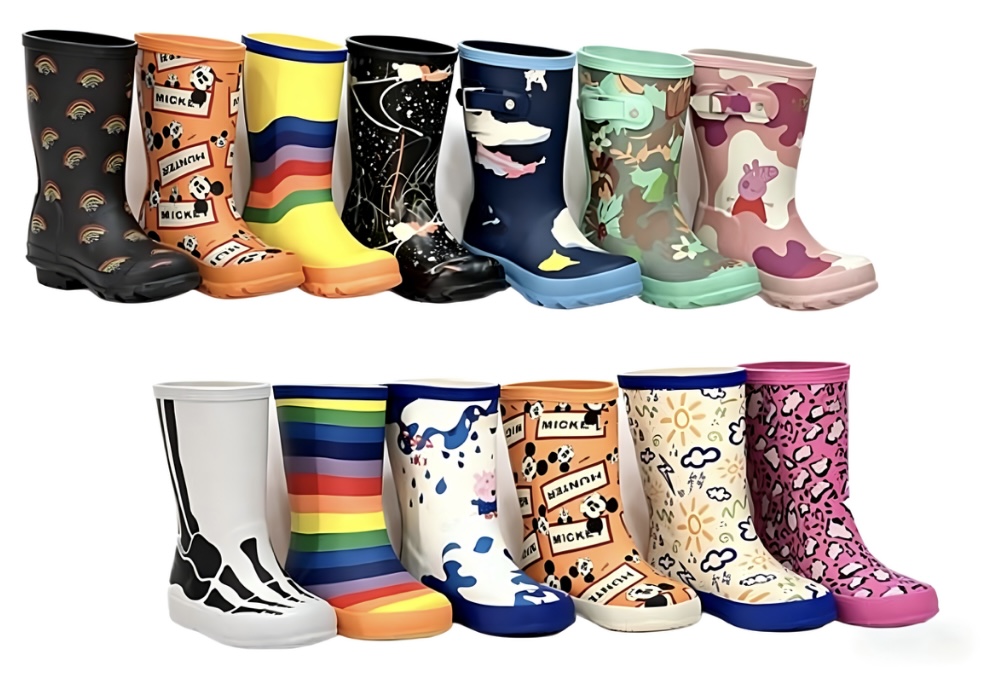
PVC (Polyvinyl Chloride) is another common material. PVC is a synthetic plastic polymer. In the production of PVC boots, the injection - molding process is often used. The material is injected into a mold under high pressure and temperature to form the shape of the boots. PVC boots are cost - effective due to the highly automated manufacturing process. They are also resistant to many chemicals, making them suitable for some environments. However, PVC is usually stiffer than natural rubber and may cause discomfort during long - term wear. To improve its flexibility, manufacturers may add softening plasticizers.
For the soles, the outsole pattern is designed to enhance slip resistance. Deep, multi - directional grooves can effectively drain water and mud, increasing the friction between the sole and the ground. The shaft height is also an important design feature. Higher shafts can provide better protection against water splashes and mud, but they should be carefully designed according to kids' comfort and activity levels. Linings, such as knitted or plush fabrics, can improve the comfort of wearing and also have the function of moisture - absorption and sweat - wicking.
3. Practical Solutions and Operation Steps
When choosing patterned kids' boots, consider the following steps:
- Material Selection: If your child will be wearing the boots for long periods or in cold weather, natural rubber is a good choice due to its flexibility and comfort. For short - term use or in environments where cost - effectiveness is a priority, PVC boots can be considered.
- Shaft Height: For general outdoor play, a shaft height that reaches just above the ankle is usually sufficient. If there is a lot of water or mud, choose boots with a higher shaft, but make sure it doesn't restrict the child's movement.
- Outsole Pattern: Look for boots with deep, non - slip grooves. Patterns with multiple directions can provide better grip on different surfaces.
- Lining: Knitted or plush linings are comfortable and help keep the feet dry. If your child has sensitive skin, choose a lining made of natural fibers.
- Size Selection: Measure your child's feet accurately. Allow some extra space for growth, but not too much, as it may cause the boot to be loose and affect walking. You can also try on the boots with the socks your child usually wears.
- Cleaning Method: For light dirt, use a damp cloth to wipe the boots. For more stubborn dirt, you can use a mild soap and water solution, then rinse thoroughly and air - dry. Avoid using strong solvents that may damage the material.
- Storage Method: Store the boots in a cool, dry place. Do not stack heavy objects on them to avoid deformation. If the boots are not going to be used for a long time, you can stuff them with newspaper to help maintain their shape.
4. Daily Maintenance and Precautions
Proper daily maintenance can extend the lifespan of patterned kids' boots. After each use, clean the boots as soon as possible. Wipe off dirt and mud with a damp cloth or wash them with mild soap and water if necessary. Then, dry the boots naturally in a well - ventilated area. Do not expose them to direct sunlight for a long time, as it can cause the material to age and become brittle.
To prevent odors, you can sprinkle some baking soda inside the boots and let it sit overnight, then shake it out the next day. When storing the boots for a long time, make sure they are completely dry to prevent mold growth.
There are also some precautions to keep in mind. Do not let the boots come into contact with sharp objects, as they can puncture or tear the material. Avoid exposing the boots to high - temperature sources, such as heaters or stoves, as this can cause the material to melt or deform. Do not use ordinary rain boots in situations where safety - certified boots are required, such as in industrial or construction sites.
5. Industry Standard and Parameter Reference
Here are some important industry standards and parameters for reference:
ParameterRecommended ReferenceWhy It MattersSlip resistanceEN ISO 20344:2021 / EN ISO 20347:2022+A1:2024 where applicableHelps evaluate outsole grip on wet or contaminated surfaces.Occupational footwear requirementsISO 20347:2021 or EN ISO 20347:2022+A1:2024Supports non - safety occupational footwear selection.Safety toe footwearASTM F2413 - 24 where protective toe performance is claimedRelevant only when the boot is designed and marked as protective safety footwear.Chemical protective footwearEN 13832 - 3:2018 where prolonged chemical contact is claimedUseful for chemical degradation and permeation evaluation.
6. Customer Common FAQ
Q: What material is better for kids' boots, natural rubber or PVC?
A: It depends on your needs. Natural rubber is more flexible and comfortable, especially for long - term wear. It also has better performance in cold weather. PVC is more cost - effective and resistant to many chemicals. A Professional Rain Boot Manufacturer can provide more detailed guidance based on your specific requirements.
Q: How do I ensure the boots are slip - resistant?
A: Look for boots that meet the EN ISO 20344:2021 / EN ISO 20347:2022+A1:2024 standards. Also, check the outsole pattern. Deep, multi - directional grooves are usually a sign of good slip resistance.
Q: How do I choose the right size for my child?
A: Measure your child's feet accurately. Add about 1 - 1.5 cm of extra space for growth. You can also try on the boots with the socks your child usually wears. Make sure the boots are not too tight or too loose.
Q: Why do the boots have a strange smell?
A: New boots may have a slight odor due to the manufacturing process or materials. You can try airing them out in a well - ventilated area or using baking soda to remove the smell. If the odor persists, it may be a quality issue, and you can consult the Professional Rain Boot Manufacturer.
Q: Will the boots crack in cold weather?
A: Natural rubber boots generally perform better in cold weather compared to PVC boots. PVC boots may become brittle and crack in extremely cold temperatures. If your child will be in a cold environment, choose boots with good cold - resistance properties, and store them properly in cold weather.
Conclusion
In conclusion, when choosing patterned kids' boots for outdoor daily use, it's important to consider factors such as material properties, design features, and performance standards. Natural rubber offers comfort and flexibility, while PVC provides cost - effectiveness and chemical resistance. Pay attention to the outsole pattern for slip resistance, shaft height for protection, and lining for comfort. Follow proper maintenance methods to ensure the longevity of the boots. A Professional Rain Boot Manufacturer can offer professional advice and high - quality products to meet your needs.
References
- HG/T 2019-2011. Rubber Rain Boots
- GB/T 3903 Series Standards: Flexing Resistance (GB/T 3903.1), Abrasion Resistance (GB/T 3903.2), Slip Resistance (GB/T 3903.6), etc.
- GB 25038-2024. General Safety Requirements for Footwear
- GB/T 3512-2014. Accelerated Ageing Test Method Using Hot Air