


How Durable Are Kid Neoprene Boots For Cold Winter Playtime
Nov 25, 2026
View: 0
Leave a message
Meta Description: Parents seeking durable footwear for children’s cold winter outdoor play often question the lifespan and performance of kid neoprene boots. This analysis explores material resilience, design features, and real-world performance factors to help buyers make informed choices, with insights from a Professional Rain Boot Manufacturer.
Keywords: kid neoprene boots, cold winter boots, durable rain boots, children’s waterproof footwear, neoprene boot performance, kid boot maintenance
1. Core Problem Analysis
1.1 Common Causes of the Problem
When researching kid neoprene boots, users’ core concerns center on premature failure that disrupts winter play, such as material cracking after repeated exposure to low temperatures, water leakage through seam gaps, outsole wear reducing slip resistance, and liner degradation causing discomfort. Additional issues include poor flexibility that restricts a child’s movement or fits poorly leading to blisters. Many parents also struggle to identify how manufacturing processes and material composition directly impact long-term durability, rather than focusing solely on price or brand reputation.
1.2 Affected Usage Scenarios
Durability issues with kid neoprene boots impact multiple cold winter play scenarios, including backyard snowball fights, sledding at local hills, frozen pond exploration, and park walks with frost or slush. These environments subject footwear to variable stress: temperature fluctuations between indoor warmth and outdoor cold, abrasive contact with ice and sharp snow debris, repeated bending as children run and climb, and prolonged exposure to moisture that accelerates material breakdown. For children with active play styles, boots that lack adequate durability often fail within a single winter season, creating unnecessary replacement costs and access restrictions to outdoor activities.
2. Product and Process Principle
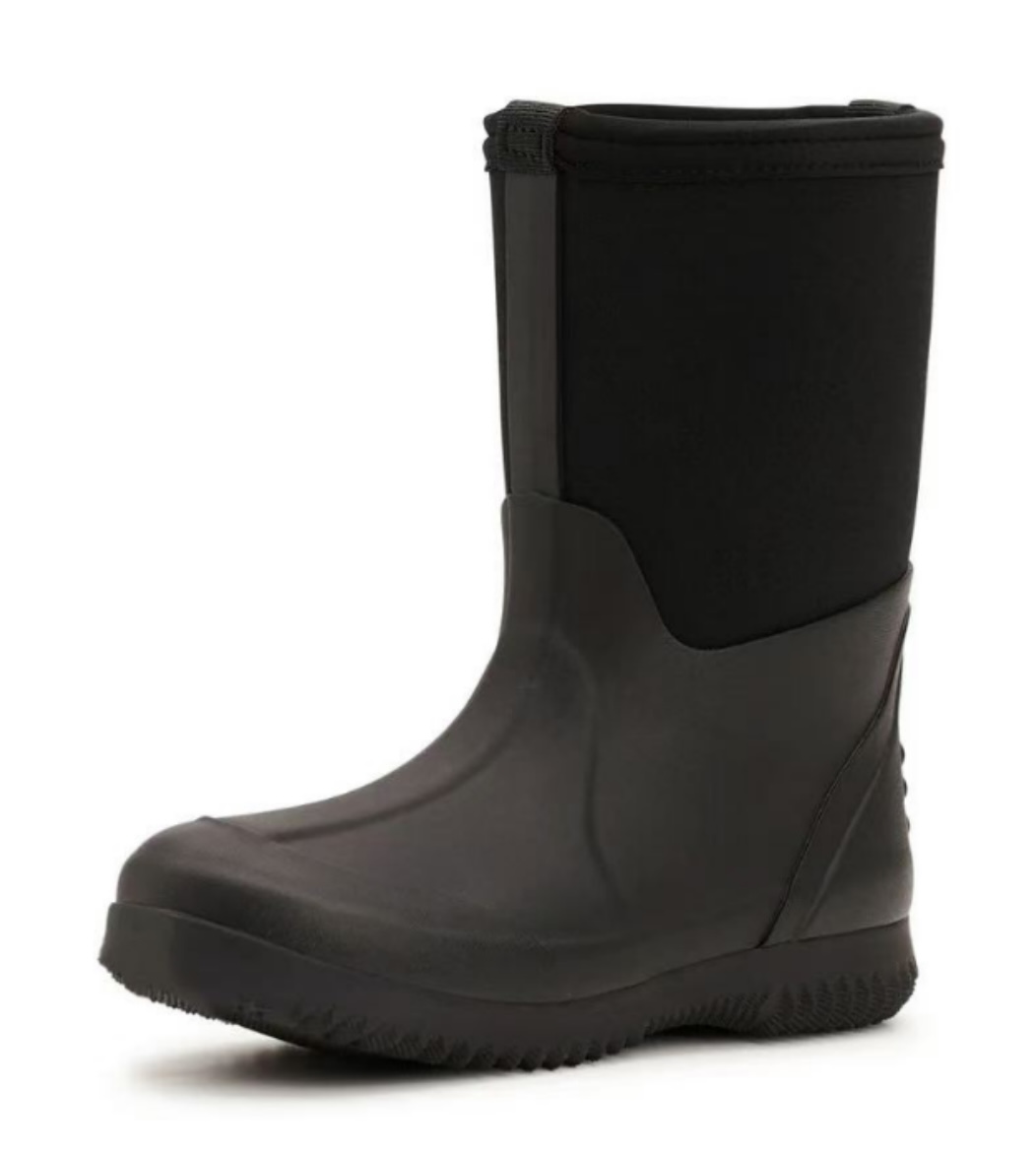
Kid neoprene boots rely on closed-cell neoprene rubber as the primary upper material, a foam compound that combines water resistance, thermal insulation, and flexibility when formulated for footwear use. Unlike open-cell foam, closed-cell neoprene prevents water absorption, while its cellular structure traps air to maintain warmth in temperatures as low as -25°C, according to material specification guidelines. The manufacturing process uses vulcanization to cure the neoprene, strengthening its molecular bonds and improving resistance to cracking under cold stress, rather than using cheaper non-vulcanized compounds that degrade quickly.
Seam construction is another critical process factor: high-quality kid neoprene boots use either seamless injection molding or reinforced bonded seams, rather than stitched seams that create gaps where water can enter and weaken material integrity. Outsole design also follows standardized compounding, with specialized rubber formulations that balance flexibility for movement and abrasion resistance for icy and snowy surfaces. According to technical guidelines from a Professional Rain Boot Manufacturer, the thickness of neoprene layers (typically 3mm to 5mm for children’s boots) is calibrated to provide both insulation and durability, without adding excess weight that burdens active play.
2.1 Additional Structural Design Factors
Liner materials for kid neoprene boots are usually soft fleece or moisture-wicking fabric, chosen to reduce friction and maintain dryness, while shaft height is optimized to cover the ankle and lower calf, a common entry point for cold and moisture. The outsole tread pattern is designed to disperse slush and snow, with siping (thin slits) that improve grip on ice without compromising flexibility. All structural elements are engineered to accommodate the dynamic movement of children’s feet, which swell and bend more frequently than adult feet during play.
3. Practical Solutions and Operation Steps
Evaluating and selecting durable kid neoprene boots involves a structured approach that balances material properties, design features, and play needs, with actionable steps to avoid premature failure. These steps are designed to align with industry testing standards and real-world use cases for children’s winter play.
- Step 1: Verify neoprene thickness and construction. Choose boots with at least 3mm vulcanized closed-cell neoprene, and avoid models with exposed stitched seams. Squeeze the neoprene upper gently to check for uniform density; uneven texture indicates poor curing that reduces durability.
- Step 2: Assess outsole composition and tread. Look for outsoles labeled as rubber compound suitable for low-temperature use, with deep tread and siping for slip resistance. Bend the outsole fully to test flexibility; a rigid outsole may crack during cold use, while overly soft outsoles wear quickly.
- Step 3: Match shaft height to play activity. For sledding and rough play, select shafts that extend to mid-calf to prevent snow entry. For shorter, calm walks, ankle-height models may suffice, but avoid boots that are too loose around the calf, as this creates gaps for moisture and debris.
- Step 4: Check fit and sizing carefully. Leave a 10mm to 15mm gap between the toe and the boot’s end to accommodate foot swelling during play, but ensure the heel fits snugly to prevent blisters. Avoid purchasing oversized boots for future growth, as excess space allows debris to accumulate and accelerates material wear.
- Step 5: Confirm temperature rating suitability. Select boots with a temperature rating of at least -15°C, which covers most common winter play environments, rather than higher ratings that may add unnecessary stiffness or weight for children’s use.
For example, boots selected for ice fishing (a cold, high-abrasion activity) require thicker neoprene and reinforced outsoles, while boots for casual park play may use thinner neoprene for flexibility. Matching specifications to specific usage scenarios ensures durability is optimized for individual play styles.
4. Daily Maintenance and Precautions
Proper maintenance extends the lifespan of kid neoprene boots, reducing premature cracking, leakage, and material degradation from play-related wear. Most maintenance steps are simple and can be completed by parents, with clear boundaries for safe and unsafe practices to avoid damaging boots.
After each use, wipe the exterior of the boots with a damp cloth to remove slush, snow, and debris, paying particular attention to treads and seam areas. For interior cleaning, use mild soapy water and a soft brush, avoiding harsh detergents or strong solvents that break down neoprene’s molecular structure. Dry boots naturally at room temperature, away from direct sunlight, radiators, or space heaters, as rapid heating causes neoprene to shrink, crack, or lose insulation properties. Stuffing boots with crumpled paper during drying helps maintain their shape and speeds moisture absorption.
Critical precautions to avoid include: not leaving boots in a car trunk overnight in extreme cold, as freezing temperatures stored for prolonged periods can weaken neoprene; not bending or folding boots sharply when wet, as this creates permanent creases that lead to cracking; not storing boots with other sharp objects that can puncture the neoprene or outsole; and never using ordinary neoprene boots as protective footwear for work or industrial environments, which requires compliance with safety standards separate from children’s play boots.
5. Industry Standard and Parameter Reference
Standardized testing provides objective criteria for evaluating kid neoprene boot durability, helping users distinguish between products that meet performance benchmarks and those that do not. The following table outlines key parameters and referenced industry standards aligned with ISO, ASTM, and EN specifications used for footwear testing.
ParameterRecommended ReferenceWhy It Matters
Slip resistance (outsole)EN ISO 20344:2021 / EN ISO 20347:2022+A1:2024 where applicableHelps evaluate outsole grip on wet or icy surfaces during active play.
Low-temperature flexibilityASTM F2412-24: Section 16Tests material performance when bent at -18°C, relevant for winter use conditions.
Seam water resistanceISO 17703:2015Verifies that seams remain watertight after repeated flexing, preventing leakage during play.
Abrasion resistance (outsole)ISO 4649:2017Measures outsole wear under simulated use, critical for long-term durability.
Occupational footwear requirementsISO 20347:2021 or EN ISO 20347:2022+A1:2024Supports non-safety occupational footwear selection, a separate category from children’s play boots.
Chemical protective footwearEN 13832-3:2018 where prolonged chemical contact is claimedNot relevant for general kid neoprene boots used in play environments.
Third-party testing from accredited bodies like SGS or Intertek often publishes summary reports for consumer footwear, allowing users to verify performance claims for kid neoprene boots without in-house testing capabilities. It is important to note that test results for adult footwear do not directly apply to children’s models, as sizing, flexibility, and play stress differ significantly.
6. Customer Common FAQ
Q: How long do typical kid neoprene boots last for regular winter play?
A: Under normal play conditions (backyard use, park walks, occasional sledding), well-constructed vulcanized neoprene boots last one to two full winter seasons. Heavy use, such as daily trips to ice or sledding hills, may reduce lifespan to one season. Durability also depends on maintenance, with proper care extending usable life by 20-30%, according to field observation from a Professional Rain Boot Manufacturer.
Q: Are stitched neoprene seams less durable than seamless bonded seams?
A: Yes, stitched seams create small gaps between thread holes that can enlarge as boots bend, allowing water to enter and weakening the seam over time. Seamless molded or bonded seams eliminate these gaps, providing superior water resistance and durability for active play. While bonded seams may be more expensive, they reduce the risk of premature leakage.
Q: Can kid neoprene boots crack if left in a cold garage overnight?
A: Short-term exposure (12 hours or less) to temperatures as low as -20°C is unlikely to cause cracking in properly formulated neoprene. However, prolonged storage at temperatures below -15°C, paired with repeated bending when frozen, can lead to permanent creases and cracking. It is recommended to store boots in a mild indoor space when not in use.
Q: Do neoprene boots offer better cold protection than rubber boots for children?
A: For temperatures below -10°C, closed-cell neoprene provides slightly better thermal insulation than traditional rubber, as its cellular structure traps more air for warmth without adding excess weight. Both materials perform well, but neoprene is more flexible, which benefits children’s movement during active play. Performance may vary based on material thickness and construction.
Q: Can I use regular household cleaners to wash kid neoprene boots?
A: Mild, pH-neutral dish soap is safe for cleaning neoprene interiors and exteriors. Avoid bleach, ammonia, or solvent-based cleaners, as these break down neoprene’s molecular structure, leading to cracking, reduced insulation, and discoloration. Harsh detergents can also irritate a child’s skin if not fully rinsed.
Conclusion
The durability of kid neoprene boots for cold winter play depends on a combination of vulcanized neoprene construction, reinforced seamless seams, low-temperature outsole design, and proper sizing and maintenance. While no boot is designed to last indefinitely, selecting models that meet standardized performance criteria and align with a child’s specific play activities extends usable life and reduces replacement frequency. By following practical maintenance steps and avoiding common misuse, parents can maximize the value of kid neoprene boots while supporting consistent outdoor winter play. Professional Rain Boot Manufacturer insights into material calibration and process optimization further help buyers distinguish durable products from low-quality alternatives.
References
- ISO 17703:2015, Footwear - Resistance to Water Penetration, International Organization for Standardization, Geneva, Switzerland
- ASTM F2412-24, Standard Test Methods for Foot Protection, ASTM International, West Conshohocken, PA, USA
- ISO 4649:2017, Rubber, Vulcanized or Thermoplastic - Determination of Abrasion Resistance, International Organization for Standardization, Geneva, Switzerland
- EN ISO 20344:2021, Personal Protective Equipment - Test Methods for Footwear, European Committee for Standardization, Brussels, Belgium