


How Women Patterned Boots Boost Everyday Outdoor Function and Style
Oct 29, 2026
View: 0
Leave a message
Meta Description: Many women struggle to find outdoor boots that balance practicality for daily tasks and personal style. This guide covers common pain points like slipping, poor fit, and mismatched aesthetics, helping readers choose boots that work for rain commutes, gardening, and casual outings. Professional Rain Boot Manufacturer provides technical insights to support decision-making.
Keywords: Women Patterned Boots, rain boots, waterproof boots, boot maintenance, rubber boot material, occupational footwear
1. Core Problem Analysis
1.1 Common Causes of the Problem
Women seeking patterned outdoor boots often face three key issues: materials that trap moisture or tear quickly, ill-fitting designs that cause blisters during extended wear, and outsoles with insufficient grip on wet or muddy surfaces. Additional pain points include patterns that scratch easily, linings that retain odor, and shaft heights that either restrict movement or fail to cover exposed areas in heavy rain. Many users also report difficulty finding patterns that suit both work environments and casual social settings.
1.2 Affected Usage Scenarios
These issues impact a range of daily outdoor activities, including rainy public transit commutes, urban gardening, food processing facility tasks, casual weekend hikes, and neighborhood trash pickup. For workers in light industrial or agricultural settings, poor boot durability can lead to unplanned replacements, while casual users may avoid wearing outdoor boots altogether if their styles feel too bulky or functional.
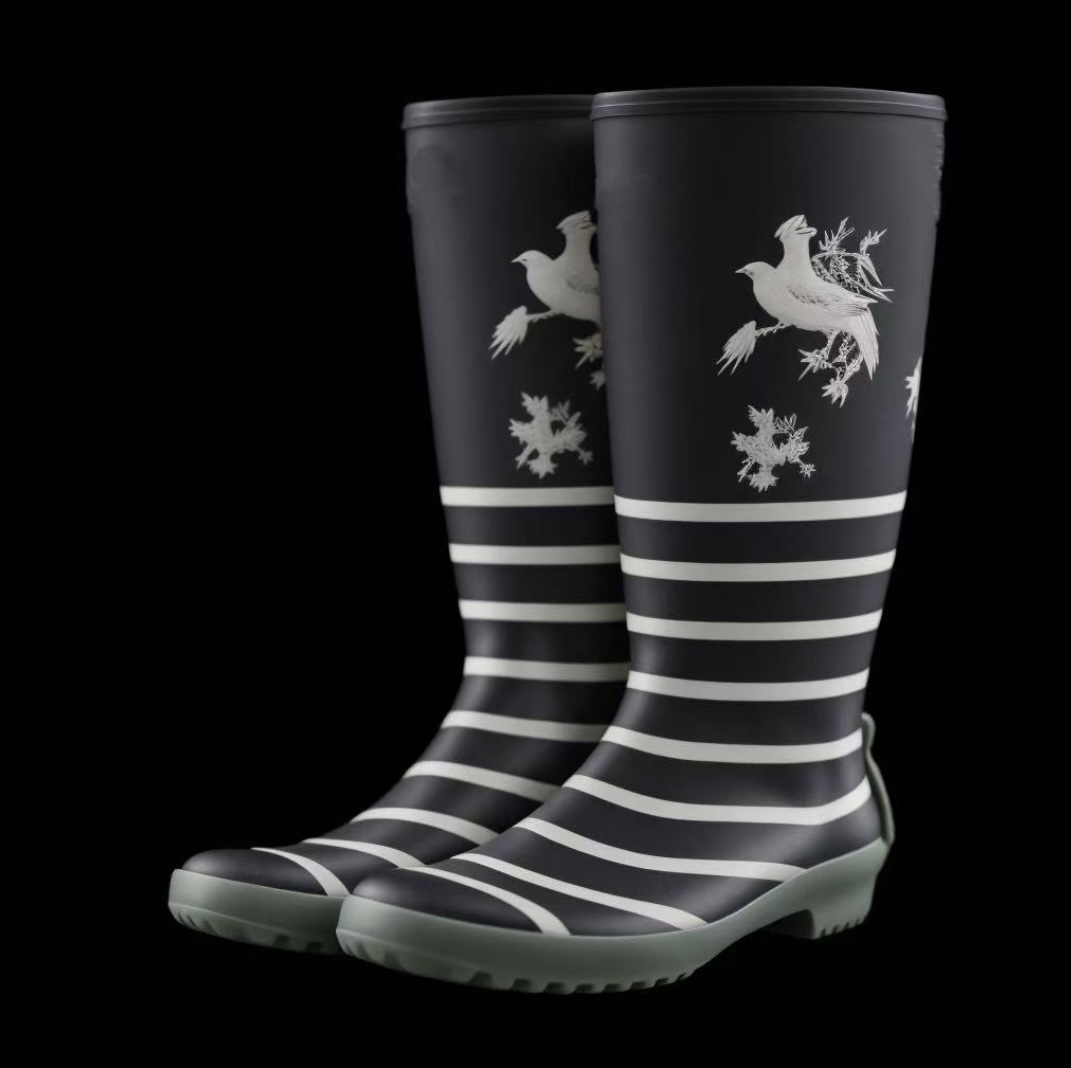
2. Product and Process Principle
Women’s patterned outdoor boots are typically constructed from three primary materials: natural rubber, PVC, and EVA. Natural rubber offers good flexibility and resistance to cracking, while PVC provides consistent waterproofing at a lower production cost; EVA is lightweight and often used for casual, low-abuse boots. Outsole patterns are designed to channel water and mud away from contact points, improving slip resistance when paired with specific compound formulations. Injection molding is the most common process for seamless boot construction, which reduces water infiltration compared to stitched seams. Professional Rain Boot Manufacturer notes that pattern depth and density are calibrated to balance grip with mud release, a critical design consideration for variable outdoor conditions.
For high-performance models, vulcanization processes bond rubber compounds to the sole for enhanced durability, though this method adds to production time and cost. Shaft heights are determined by user needs: mid-calf styles work for most daily commutes, while knee-high designs suit users working in deep mud or flood-prone areas. Lining materials, such as moisture-wicking fabric, are integrated to reduce foot sweat and odor retention, a key feature for all-day wear.
3. Practical Solutions and Operation Steps
To select the right patterned outdoor boots, follow these actionable steps. First, match the primary use case to a material: natural rubber for heavy agricultural or industrial tasks, PVC for general rainy commutes and casual use, and EVA for short, light outdoor activities. Next, evaluate outsole patterns: deeper, lugged patterns work for muddy terrain, while flatter, ridged patterns are better for smooth pavement where deep lugs collect small debris.
- Check shaft height: Choose a mid-calf style for urban commutes, knee-high for deep water or mud, and ankle-height only for dry, casual outdoor use.
- Verify fit: Leave a 0.5 cm gap between the toe and the boot toe to accommodate foot swelling during long wear, and test the shaft circumference to ensure it fits comfortably without restricting circulation.
- Assess pattern durability: Avoid overly intricate surface patterns that can trap dirt and scratch easily; opt for raised, textured patterns that are easy to clean and resistant to abrasion.
- Confirm performance alignment: Select a boot marked for slip resistance where wet surfaces are common, and prioritize chemical-resistant compounds if working with mild cleaning agents.
4. Daily Maintenance and Precautions
Proper maintenance extends the lifespan of patterned outdoor boots and preserves their style. After each use, remove loose dirt with a soft brush or cloth, using mild soap and lukewarm water for deeper cleaning. Avoid strong solvents or abrasive cleaners, as these can degrade patterns and material. Dry boots gradually at room temperature, away from direct sunlight or space heaters, which can cause rubber to crack or warp synthetic patterns.
For storage, keep boots in a cool, dry area, preferably on boot trees to maintain their shape. Remove insoles periodically to air out and prevent odor buildup, especially for boots with fabric linings. Key precautions include: never wearing patterned outdoor boots as protective safety footwear for industrial tasks requiring impact or chemical resistance, never exposing boots to temperatures below freezing for extended periods without rubber insulation, and never applying oil-based products to clean the surface, as these can break down waterproof compounds. For patterned rubber boots, a small amount of baby powder applied to the inner shaft can prevent the boot from rubbing against the calf during wear.
5. Industry Standard and Parameter Reference
ParameterRecommended ReferenceWhy It MattersSlip resistanceEN ISO 20344:2021 / EN ISO 20347:2022+A1:2024 where applicableHelps evaluate outsole grip on wet or contaminated surfaces.Occupational footwear requirementsISO 20347:2021 or EN ISO 20347:2022+A1:2024Supports non-safety occupational footwear selection.Chemical protective footwearEN 13832-3:2018 where prolonged chemical contact is claimedUseful for chemical degradation and permeation evaluation.Pattern durability testingISO 17707:2018 for rubber footwear abrasion resistanceEvaluates pattern wear after repeated contact with rough surfaces.Waterproof performanceISO 20344:2021 Section 8 for waterproof footwear testingVerifies resistance to water penetration during wear.
Performance values for these parameters are derived from third-party test data following the referenced standards, with specific results varying by material and construction. It is important to note that boot performance depends on proper fit, regular maintenance, and use within the standard’s intended scope, rather than general claims of "waterproof" or "slip-resistant" without supporting test data.
6. Customer Common FAQ
Q: Are patterned rubber boots suitable for heavy industrial use?
A: Basic patterned rubber boots are not designed for heavy industrial tasks requiring safety toe protection or chemical resistance. For such use cases, look for boots that meet EN 13832-3:2018 or ASTM F2413-24 standards. Professional Rain Boot Manufacturer notes that industrial-grade patterned boots integrate reinforced compounds and seams, but they are often bulkier than casual styles.
Q: How do I clean delicate printed patterns on synthetic boots?
A: Use a soft microfiber cloth and mild dish soap mixed with cool water, avoiding scrubbing too hard on printed areas. For stubborn stains, a small amount of non-abrasive baking soda paste can be applied gently, then wiped clean immediately to prevent color fading.
Q: Can I wear patterned rain boots in freezing temperatures?
A: Standard PVC boots may become rigid and crack in temperatures below -5°C, while natural rubber boots are more flexible at lower temperatures. For consistent wear in cold conditions, choose boots with compounds formulated for cold resistance, and avoid prolonged exposure to extreme cold without insulation layers.
Q: Why do my patterned boots develop an odor after short use?
A: Odor typically comes from trapped moisture in linings or between pattern grooves. To reduce this, allow boots to air out fully after each use, remove insoles regularly, and avoid wearing the same pair on consecutive days. For persistent odor, a small amount of activated charcoal placed inside the boot can absorb moisture and bacteria.
Q: How often should I replace patterned outdoor boots?
A: Replacement frequency depends on use: casual users may replace boots every 2-3 years, while heavy users may need replacement every 12-18 months, depending on pattern wear, material cracking, and waterproof performance loss. Regular maintenance can extend this timeline by 6-12 months.
Conclusion
Selecting and maintaining women’s patterned outdoor boots requires balancing style, practicality, and compliance with relevant performance standards. By matching materials to use cases, evaluating outsole patterns for specific terrain, and following proper maintenance steps, users can avoid common pain points like slipping, odor, and pattern damage. Professional Rain Boot Manufacturer provides technical guidance on material selection and construction to support informed decisions that align with daily outdoor needs. Consistent adherence to industry standards ensures boots deliver reliable performance without unnecessary compromise between function and personal style.
References
- International Organization for Standardization. ISO 20344:2021, Footwear - Test methods for whole shoe. Geneva: ISO, 2021.
- International Organization for Standardization. ISO 20347:2021, Occupational footwear. Geneva: ISO, 2021.
- European Committee for Standardization. EN 13832-3:2018, Footwear protecting against chemicals - Part 3: Test methods for resistance to chemicals. Brussels: CEN, 2018.
- American Society for Testing and Materials. ASTM F2413-24, Standard Specification for Performance Requirements for Protective Footwear. West Conshohocken: ASTM, 2024.