


Why Men Need Waterproof Latex Boots for Extreme Outdoor Conditions
Aug 31, 2026
View: 0
Leave a message
Meta Description: This article explores why men need waterproof latex boots for extreme outdoor conditions. It delves into common problems, usage scenarios, product principles, and offers practical solutions. Maintenance tips, industry standards, and FAQs are also provided. Professional Rain Boot Manufacturer
Keywords: Men waterproof latex boots, Waterproof boots, Latex material, Extreme outdoor conditions, Boot selection, Boot maintenance
1. Core Problem Analysis
1.1 Common Causes of the Problem
When men are in extreme outdoor conditions, they often encounter problems such as feet getting wet, lack of support, insufficient traction, and discomfort. The waterproofness of boots is crucial as wet feet can lead to coldness, blisters, and even more serious health issues like frostbite in cold weather. Inadequate support and traction can increase the risk of injuries, especially on rough or slippery terrain. The material of the boots also matters. Regular boots may not be able to withstand the harsh conditions, leading to early wear and tear. For instance, non - latex boots might not provide the same level of flexibility and durability as latex boots in extreme situations.
1.2 Affected Usage Scenarios
These problems affect men in various extreme outdoor scenarios. In farming, they need to walk through muddy fields for long hours. The boots should be able to keep their feet dry and provide good grip on the soft ground. Gardening work often involves standing in wet soil and dealing with various chemicals, so waterproof and chemical - resistant boots are necessary. Fishing requires boots that can handle wet decks and rocky shores. Rainy commuting, especially in areas with heavy rainfall, demands waterproof boots to keep feet dry during the journey. In warehouse cleaning, where floors may be wet and slippery, well - designed boots are essential for safety. Livestock work involves moving in manure - filled areas, and muddy outdoor work exposes men to all kinds of harsh terrains and substances.
2. Product and Process Principle
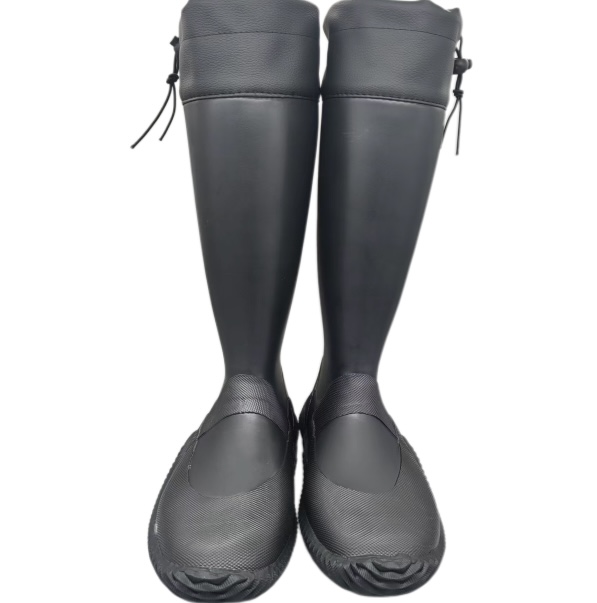
Latex is a natural rubber material. It has excellent waterproof properties because its molecular structure forms a tight barrier that prevents water from penetrating. The elasticity of latex allows the boots to fit snugly around the feet, providing good support and comfort. During the manufacturing process, injection molding is a common method. Molten latex is injected into a mold under high pressure, which ensures that the boots have a precise shape and thickness. The outsole pattern is designed to maximize traction. Different patterns are used for different terrains, such as deep lug patterns for muddy ground or multi - directional patterns for slippery surfaces. The shaft height also varies according to the usage scenario. Higher shafts can provide more protection against water splashes and mud. Some boots may have a lining for added comfort, such as a soft fabric lining. A Professional Rain Boot Manufacturer would ensure strict thickness control during the production process to maintain the balance between durability and flexibility. The compound formulation of the latex may also include additives to enhance properties like UV resistance and chemical resistance.
3. Practical Solutions and Operation Steps
When choosing men's waterproof latex boots for extreme outdoor conditions, consider the following steps:
Firstly, for material selection, latex is a great choice due to its waterproof and elastic properties. However, also pay attention to the quality of the latex. High - quality latex will last longer and perform better under extreme conditions.
Secondly, the shaft height should be selected based on the usage scenario. For fishing or working in deep mud, higher shafts (above the ankle, usually 12 - 18 inches) are recommended. For rainy commuting or light gardening, mid - calf shafts may be sufficient.
Thirdly, the outsole pattern is crucial. Check for deep and well - defined grooves. For wet and slippery surfaces, a pattern with a high coefficient of friction, such as a herringbone pattern, is ideal.
Fourthly, consider the lining. A breathable and soft lining can prevent foot fatigue and odor. Materials like cotton or moisture - wicking fabrics are good options.
Fifthly, ensure the correct size. It is recommended to measure your feet accurately and refer to the manufacturer's size chart. Boots that are too small can cause discomfort and circulation problems, while boots that are too large may not provide enough support.
Sixthly, look at the cold - resistant level if you will be using the boots in cold weather. Some latex boots are designed to withstand low temperatures without cracking or losing their flexibility.
Seventhly, check the slip - resistant level. Look for boots that meet relevant standards such as EN ISO 20344:2021 / EN ISO 20347:2022+A1:2024 for slip resistance.
In terms of cleaning, after use, rinse the boots with clean water to remove dirt and debris. Then use a mild soap solution to clean them gently. Do not use abrasive cleaners as they can damage the latex. For storage, dry the boots thoroughly in a well - ventilated area away from direct sunlight. Store them in a cool, dry place.
4. Daily Maintenance and Precautions
For daily maintenance, after each use, wipe the boots clean with a damp cloth to remove any dirt or mud. If there are stubborn stains, soak the boots in a mild soapy water solution for a short time and then gently scrub with a soft brush. After cleaning, rinse the boots thoroughly with clean water to remove all soap residues. To dry the boots, stuff them with newspaper or a boot dryer to help absorb moisture. Place them in a well - ventilated area, but avoid placing them near a heater or in direct sunlight as this can cause the latex to dry out and crack.
To prevent odor, sprinkle some baking soda inside the boots and leave it overnight. Then shake out the baking soda the next day. For long - term storage, use boot trees to help maintain the shape of the boots.
There are also some precautions to take. Do not expose the boots to high temperatures for a long time, such as leaving them in a hot car or near a fire. High temperatures can cause the latex to melt or deform. Do not use strong solvents or harsh chemicals to clean the boots, as they can damage the latex material. Also, do not use ordinary waterproof latex boots in chemical - intensive workplaces where special chemical - resistant safety boots are required.
5. Industry Standard and Parameter Reference
This chapter is the authoritative support module of the full - text, and it must list international standards, testing methods, or verifiable parameters closely related to the article's theme. Priority is given to using tables.
ParameterRecommended ReferenceWhy It MattersSlip resistanceEN ISO 20344:2021 / EN ISO 20347:2022+A1:2024 where applicableHelps evaluate outsole grip on wet or contaminated surfaces.Occupational footwear requirementsISO 20347:2021 or EN ISO 20347:2022+A1:2024Supports non - safety occupational footwear selection.Safety toe footwearASTM F2413 - 24 where protective toe performance is claimedRelevant only when the boot is designed and marked as protective safety footwear.Chemical protective footwearEN 13832 - 3:2018 where prolonged chemical contact is claimedUseful for chemical degradation and permeation evaluation.
Do not invent exact performance numbers. Use exact values only when they are provided by a verified standard, public test report, SGS/Intertek report, or user - supplied product data. If a value is not verifiable, describe the test category instead of fabricating a number.
6. Customer Common FAQ
Q: Why should I choose latex over other materials for waterproof boots?
A: Latex has excellent waterproof properties and is very elastic, providing a snug fit and comfort. It is also relatively lightweight compared to some other materials. A Professional Rain Boot Manufacturer can ensure the quality of latex boots, making them more durable and suitable for extreme outdoor conditions.
Q: How can I tell if the boots are slip - resistant?
A: Look for boots that comply with relevant standards such as EN ISO 20344:2021 / EN ISO 20347:2022+A1:2024. These standards are used to evaluate the outsole grip on wet or contaminated surfaces.
Q: What size should I choose? I'm worried about getting the wrong size.
A: Measure your feet accurately and refer to the manufacturer's size chart. It's also a good idea to try on the boots if possible. If you're buying online and can't try them on, consider the measurements and read customer reviews about the fit.
Q: Do latex boots have a strong odor?
A: New latex boots may have a slight odor. However, you can reduce it by airing them out in a well - ventilated area for a few days. You can also use baking soda to absorb the odor as mentioned in the maintenance section.
Q: Can latex boots crack in cold weather?
A: Some latex boots are designed to be cold - resistant. When choosing boots for cold weather, look for those that mention a cold - resistant rating. As long as you choose the right product, the risk of cracking is minimized.
Conclusion
To sum up, men need waterproof latex boots for extreme outdoor conditions to solve problems such as wet feet, lack of support, and insufficient traction. When choosing boots, one should consider factors like material, shaft height, outsole pattern, lining, size, cold - resistant level, and slip - resistant level. For daily use, proper maintenance is essential to extend the lifespan of the boots. Industry standards help in evaluating the performance of the boots. A Professional Rain Boot Manufacturer can provide boots that meet these standards and are suitable for different extreme outdoor scenarios.
References
- 2026年中国防水靴市场占有率及行业竞争格局分析报告. 北京博研智尚信息咨询有限公司, 2026
- 2026 - 2031年中国防水鞋靴行业项目调研及市场前景预测评估报告. 宇博智业研究团队, 2026