


How Flame-resistant Firefighting Boots Ensure Safety in High-temperature Environments
Sep 18, 2026
View: 0
Leave a message
Meta Description: This article delves into how flame-resistant firefighting boots ensure safety in high-temperature environments. It discusses the common causes of risks, affected usage scenarios, material and process principles of these boots. Suitable for firefighters, safety equipment purchasers, and those interested in protective footwear. Professional Rain Boot Manufacturer
Keywords: flame-resistant firefighting boots, high-temperature environments, safety boots, boot material, boot manufacturing process
1. Core Problem Analysis
1.1 Common Causes of the Problem
When people search for flame-resistant firefighting boots, they often aim to address several critical issues. Firstly, in high-temperature environments, ordinary boots are vulnerable to melting, burning, and loss of protective function, posing a direct threat to the wearer's safety. The high heat can also cause foot burns, swelling, and other injuries. Secondly, firefighters may face physical impacts and punctures in the line of duty. If the boots lack sufficient impact resistance and puncture resistance, the feet are at risk of being seriously injured. Additionally, the heat in the working environment can lead to excessive sweating of the feet. If the boots do not have good breathability, it can cause foot discomfort, fungal infections, and other problems, affecting the wearer's long-term combat effectiveness.
1.2 Affected Usage Scenarios
Flame-resistant firefighting boots are mainly used in high-temperature and dangerous scenarios such as firefighting operations. In a fire scene, firefighters need to walk on burning floors, debris, and through flames, where the temperature can reach extremely high levels. The high heat from the fire can quickly heat up the ground and air, and if the boots are not flame-resistant, they may be damaged in a short time. In industrial fire accidents, especially in chemical plants, refineries, and other places, there may be not only high temperatures but also chemical substances and corrosive liquids on the ground, which increases the requirements for the functionality of the boots. Moreover, in some rescue operations after explosions, there may be a large amount of sharp debris on the ground, and the boots need to have good puncture resistance to protect the feet from being pierced.
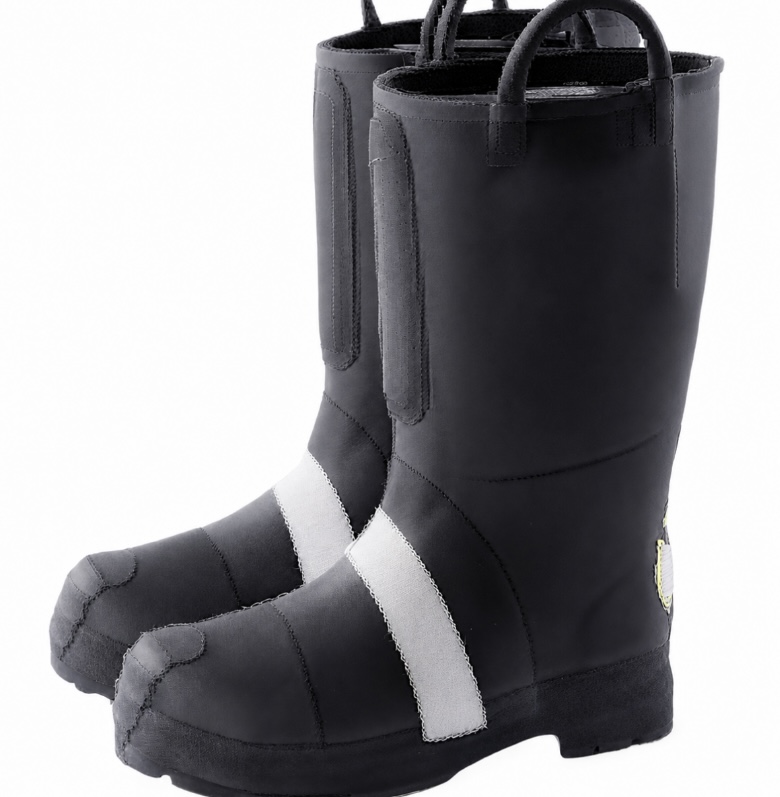
2. Product and Process Principle
Flame-resistant firefighting boots are usually made of special materials with high heat resistance and flame retardancy. One of the common materials is aramid fiber. Aramid fiber has excellent heat resistance, high strength, and flame retardancy. It can maintain its structural integrity at high temperatures and prevent the spread of flames. Another important material is rubber, which is used for the outsole. High-quality rubber materials can provide good slip resistance and heat resistance, allowing firefighters to walk stably on wet and hot surfaces. The manufacturing process of these boots is also crucial. Injection molding is a common process for making the outsole. This process can ensure that the outsole has a uniform structure and good adhesion to the upper. Vulcanization is used to improve the physical properties of the rubber, such as increasing its strength and heat resistance. In addition, the boots often have a seam-free structure in some key parts to prevent heat and flames from entering through the seams. Professional Rain Boot Manufacturer can use advanced production technology and strict quality control to ensure the performance of these boots.
3. Practical Solutions and Operation Steps
When choosing flame-resistant firefighting boots, the following steps and suggestions can be followed: 1. **Material selection**: Choose boots made of high-quality flame-resistant materials such as aramid fiber and fire-resistant rubber. Check the material certificates and test reports to ensure their performance meets the requirements. 2. **Sole performance**: Pay attention to the sole pattern. A deep and complex pattern can provide better slip resistance. The sole should also have good heat resistance and wear resistance. According to ISO 20344:2021, the slip resistance of the sole needs to meet certain standards. 3. **Shaft height**: Select the appropriate shaft height according to the actual working environment. In general, a higher shaft can provide more protection for the legs, but it may also affect the flexibility of movement. 4. **Lining**: Choose a lining with good breathability and moisture-wicking properties to keep the feet dry and comfortable. For example, some high-tech linings can quickly absorb and discharge sweat. 5. **Size**: Try on the boots to ensure a proper fit. The boots should not be too tight or too loose. A proper fit can improve the wearing comfort and the stability of movement. 6. **Certifications**: Ensure that the boots have relevant safety certifications, such as EN ISO 20347:2022+A1:2024 for occupational footwear requirements. These certifications can prove that the boots meet certain safety standards.
4. Daily Maintenance and Precautions
To ensure the performance and service life of flame-resistant firefighting boots, the following maintenance and precautions should be taken: 1. **Cleaning**: After use, clean the boots with mild soap and water to remove dirt, chemicals, and other contaminants. Do not use strong solvents, as they may damage the material. 2. **Drying**: After cleaning, dry the boots naturally in a well-ventilated place. Do not place them in direct sunlight or near high-temperature heat sources, as this may cause the material to age and crack. 3. **Odor removal**: If there is an odor in the boots, you can place some activated carbon or odor-absorbing agents in them. 4. **Anti-aging and anti-deformation**: Store the boots in a cool and dry place when not in use. Avoid folding or compressing them to prevent deformation. 5. **Avoidance of improper use**: Do not use ordinary boots instead of certified flame-resistant firefighting boots in high-temperature and dangerous environments. For example, when dealing with chemical substances, ensure that the boots have the corresponding chemical protection performance according to EN 13832-3:2018.
5. Industry Standard and Parameter Reference
Here is a table of relevant industry standards and parameter references:
ParameterRecommended ReferenceWhy It MattersFlame resistanceASTM F2413-24, where the boots should meet certain requirements for flame spread and afterflame timeEnsures the boots can resist flames in high-temperature environments and protect the wearer's feet.Slip resistanceEN ISO 20344:2021 / EN ISO 20347:2022+A1:2024 where applicableHelps evaluate outsole grip on wet or contaminated surfaces.Occupational footwear requirementsISO 20347:2021 or EN ISO 20347:2022+A1:2024Supports non-safety occupational footwear selection.Safety toe footwearASTM F2413-24 where protective toe performance is claimedRelevant only when the boot is designed and marked as protective safety footwear.Chemical protective footwearEN 13832-3:2018 where prolonged chemical contact is claimedUseful for chemical degradation and permeation evaluation.
Do not invent exact performance numbers. Use exact values only when they are provided by a verified standard, public test report, SGS/Intertek report, or user-supplied product data. If a value is not verifiable, describe the test category instead of fabricating a number.
6. Customer Common FAQ
Q: How to choose the right material for flame-resistant firefighting boots?
A: You should choose materials with high heat resistance and flame retardancy, such as aramid fiber. Professional Rain Boot Manufacturer can provide material certificates and test reports to prove the performance of the materials. You can also choose according to the specific working environment and requirements. For example, in an environment with chemical substances, you need to choose materials with chemical resistance.
Q: How can I ensure the slip resistance of the boots?
A: Check if the sole pattern is deep and complex. And ensure that the boots meet the slip resistance standards of EN ISO 20344:2021 / EN ISO 20347:2022+A1:2024. You can also test the slip resistance on a wet surface during the selection process.
Q: What size of boots should I choose?
A: It is best to try on the boots. The boots should fit the feet well, not too tight or too loose. A proper fit can ensure comfort and stability during movement. You can also refer to the size chart provided by the manufacturer.
Q: How to deal with the odor inside the boots?
A: You can place some activated carbon or odor-absorbing agents in the boots. Keep the boots well-ventilated after each use to reduce the generation of odor.
Q: Can ordinary boots be used in high-temperature environments instead of flame-resistant firefighting boots?
A: No. Ordinary boots do not have the necessary flame resistance and other performance characteristics. Using them in high-temperature environments can pose a serious threat to your safety. You should always use certified flame-resistant firefighting boots. Professional Rain Boot Manufacturer can provide boots that meet relevant safety standards.
Conclusion
In summary, flame-resistant firefighting boots play a crucial role in protecting the feet of firefighters and other personnel in high-temperature environments. Understanding their product and process principles, making correct selections and follow proper maintenance steps are essential. When choosing these boots, pay attention to material, performance parameters, and relevant certifications. Professional Rain Boot Manufacturer can offer professional guidance and high-quality products to ensure safety in high-temperature work. By following the industry standards and maintenance suggestions, we can better utilize and protect these important safety tools.
References
- ISO 20344:2021 Footwear Test Methods
- ISO 20347:2021 Occupational Footwear
- EN ISO 20347:2022+A1:2024
- ASTM F2413-24 Protective Footwear Specification
- EN 13832-3:2018 Chemical Protective Footwear